
Curiosity begins with paying attention. What happens next depends on whether we act on what we notice.
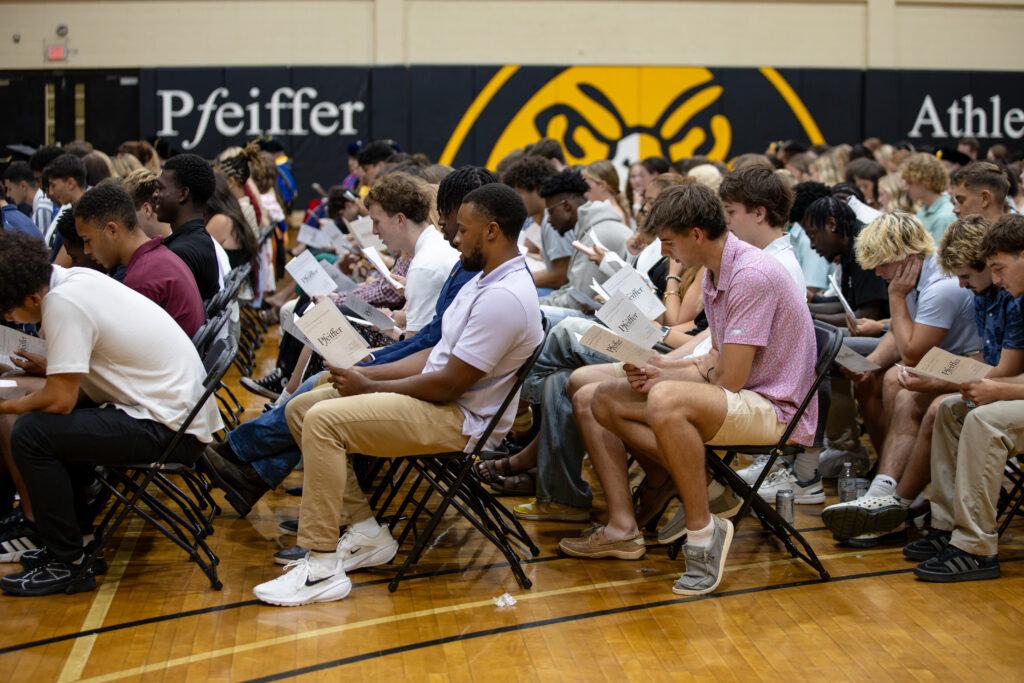
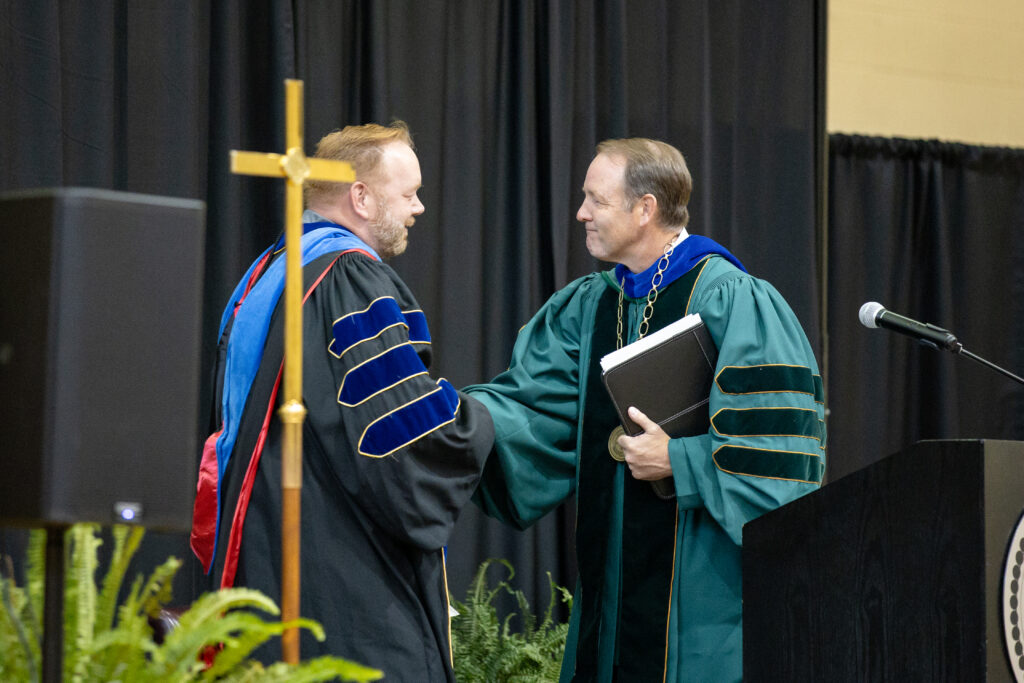
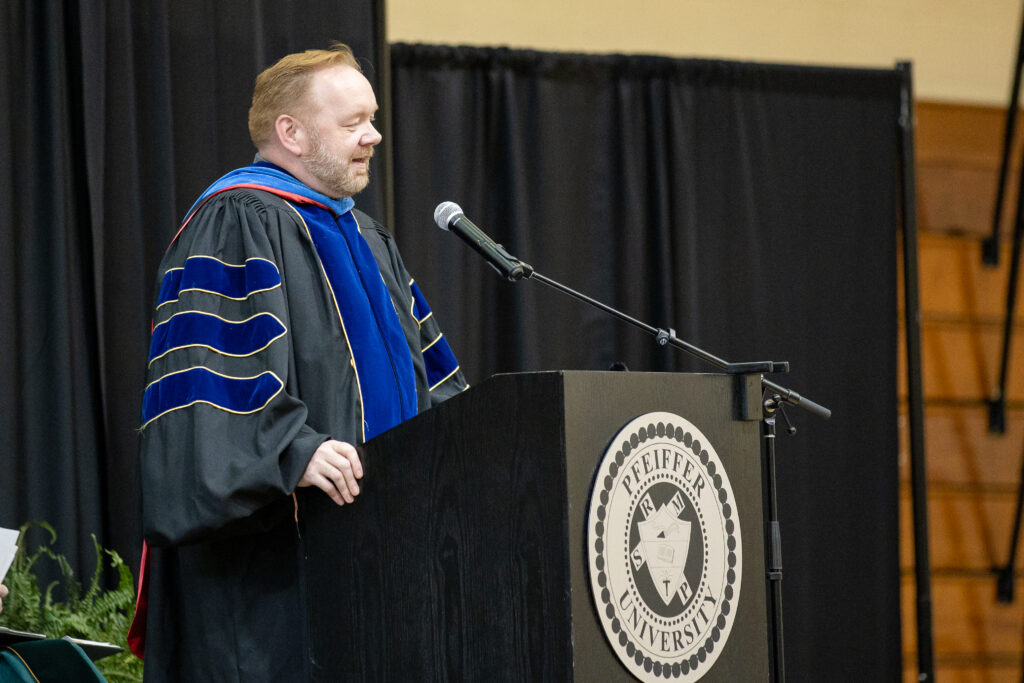
A few weeks into my new role as Provost and Vice President for Academic Affairs at Pfeiffer University, I had the privilege of addressing students, faculty, and staff at our fall convocation.
In some ways, I felt a particular connection with the first-year students sitting before me. I am new to Pfeiffer, too. Although I am certainly not new to higher education, I am experiencing many of the same firsts: learning the campus, meeting new people, discovering traditions, and beginning to understand what makes this community distinctive.
Convocation offered an opportunity to begin that academic year together.
Before I spoke, senior Kamani Spencer shared her own Pfeiffer story. She arrived as a soccer player and later accepted an invitation to try lacrosse, despite never having played the sport. The decision brought challenges, mistakes, friendships, and a new community she could not have anticipated when she first arrived.
Her message to students was to take chances, try unfamiliar things, and allow adversity to change them without letting it define them.
That was an especially fitting introduction to a morning centered on learning, growth, and the possibilities that emerge when we remain open to what we did not expect.
A Small Arrow and a One-Page Memo
I began my address with an ordinary experience from a rainy day in April 1986.
Jim Moylan, an employee at Ford Motor Company, borrowed a company car to drive to a meeting. Shortly after leaving, he noticed that the vehicle was nearly out of gas. He pulled into a station, stepped into the rain, and stopped beside a pump.
Then he discovered that the fuel door was on the other side of the car.
Moylan climbed back inside, repositioned the vehicle, and finished refueling, by then thoroughly soaked. When he returned to his office, he sat down and wrote a memo with the wonderfully unremarkable subject line “Product Convenience Suggestion.”
He proposed adding a small indicator near the fuel gauge to show drivers which side of the vehicle held the fuel door. He explained the problem, anticipated concerns about cost, and included a sketch.
Ford eventually developed the idea and introduced it in its vehicles. Other manufacturers followed. Today, a version of Moylan’s suggestion appears in nearly every modern vehicle.
Beside the fuel-pump symbol on the dashboard is a small triangle. If it points left, the fuel door is on the left. If it points right, the fuel door is on the right.
It is known as the Moylan Arrow.
Moylan experienced something countless drivers had experienced before him. He paid attention to it long enough for the inconvenience to become a question.
Then he gave that question somewhere to go.
The Pause Before Moving On
Curiosity often begins in the pause between experiencing something and moving past it.
Most days, our experiences disappear quickly beneath whatever demands our attention next. We notice something interesting, inconvenient, confusing, or unexpected. For a moment, it holds our attention. Then the next meeting begins, another notification appears, or a new obligation takes its place.
Moylan allowed one small experience to remain with him. He stayed with it long enough to ask whether something familiar could work differently.
Attention creates an opening for curiosity. Curiosity produces questions. Questions can give us direction.
Sometimes that direction leads to an invention. More often, it helps us understand another person more fully, reconsider an assumption, recognize an opportunity, or see a familiar problem differently.
A university brings us into sustained contact with ideas and people beyond what we already know. At its best, it gives us room to examine what we encounter and consider where it might lead.
That makes a university one of the best places in which to practice paying attention.
What College Places Before Us
College can easily begin to feel like a sequence of requirements to complete. Finish the course. Earn the credit. Submit the assignment. Satisfy the requirement. Move on to whatever comes next.
Each of those steps matters. Education also takes shape through the connections students make between what they study, what they experience, and what they may someday contribute.
The credits students earn will appear on their transcripts. Curiosity develops capacities that are harder to record: asking better questions, connecting ideas that initially seem unrelated, listening carefully to another person, and continuing to learn when no one is assigning the work.
Those capacities remain important long after graduation.
Credits will be recorded. Deeper connections will not form automatically. They require attention.
I asked Pfeiffer students to direct that attention in three directions.
Pay Attention to What Draws You
First, notice the idea that remains with you after class has ended. Pay attention to the subject that interests you more than you expected or the question that keeps returning.
Curiosity requires discipline. It may ask you to read one more source, raise a question after class, or follow a more demanding route toward understanding. The path may take longer than expected, and its destination may initially be unclear.
Sometimes curiosity leads down a rabbit hole.
While preparing the address, I found myself exploring stories of familiar objects and discoveries that began with someone noticing something unusual. George de Mestral examined the burrs clinging to his clothing and his dog’s fur, eventually developing Velcro. Percy Spencer noticed that a candy bar had melted in his pocket while he worked near radar equipment, helping lead to the microwave oven. Spencer Silver developed an adhesive too weak for its original purpose. Art Fry later realized it could hold a bookmark in place without damaging a page, and the Post-it Note followed.
I even became curious about the phrase “going down a rabbit hole” and promptly went down a rabbit hole about rabbit holes.
College is a particularly good time to follow a few of them. The most productive rabbit holes have a question attached. Follow one far enough to discover what is there. Then bring something back with you: an insight, an unexpected connection, or an even better question.
Pay Attention to the People Around You
Ideas rarely develop in isolation. They grow through conversation, challenge, and the perspectives of people who see something we have missed.
Every person within a university community carries experiences and ways of seeing the world that others do not yet fully understand. A professor may introduce a student to a field they did not know existed. A classmate may challenge an assumption they have never examined. A coach, staff member, or mentor may recognize a strength the student has not yet learned to see.
Relationships also have long and unpredictable timelines. Someone we meet today may influence a decision tomorrow, connect us with an opportunity years from now, or reenter our lives decades later.
We rarely know when an ordinary conversation is becoming the beginning of an important relationship.
Paying attention to another person is a form of respect. It communicates that the person matters, that their experience is worth understanding, and that we may have something to learn from them.
Pay Attention to What Does Not Go as Expected
A course may prove more difficult than anticipated. A project may produce a result that cannot be explained. A plan that once seemed certain may suddenly have to change.
Our first impulse is often to correct the problem quickly and return to the original plan. Curiosity invites us to pause and ask, “What is this experience showing me?”
Those of us trained as scientists learn that an unexpected result is still information. It may reveal a mistake in the process, challenge an assumption, or point toward something we had not considered.
The same is true beyond the laboratory.
That kind of attention requires courage. The answer may ask us to change our minds, adjust our plans, reconsider an established approach, or acknowledge that we need help.
Moylan’s rainy stop at the gas station was an inconvenience. He treated it as information.
The experiences that interrupt our plans may also have something to teach us.
Teaching That Pays Attention
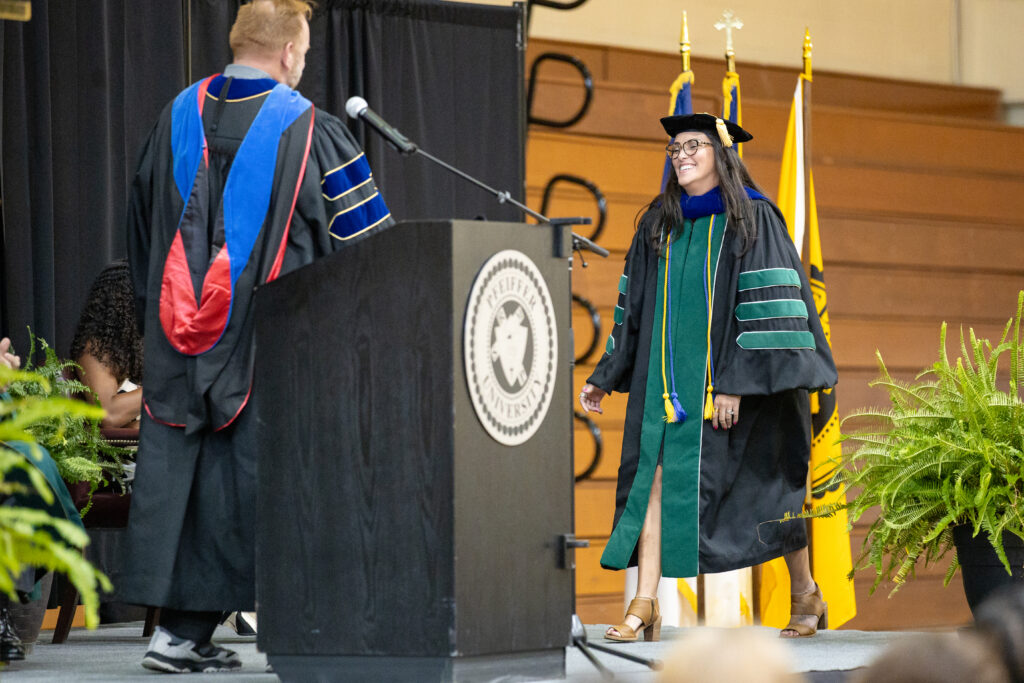
Following my address, I had the privilege of presenting the 2026 Mary E. Foster Webb and Henry Thomas “Toby” Webb Jr. Award for Excellence in Teaching.
The Webb Award recognizes teaching marked by excellence, innovation, responsiveness, and genuine care for students. What made this year’s recognition particularly meaningful was the way the student nomination described those qualities in practice.
The nomination centered on a professor who listens.
When a difficult exam revealed that students needed more time, the professor adjusted the pace. When an assignment was not helping students understand the material as intended, she reconsidered its design. Her lessons made complex material manageable while helping students connect classroom learning with situations they might encounter in clinical practice.
The same care extended beyond the classroom. She made time to explain difficult concepts, discuss students’ future goals, and check on those who might be struggling. Those actions created the trust students need to ask questions, take intellectual risks, and recover from mistakes.
The nomination also described a teacher who continues learning. She welcomes feedback, reflects honestly on her practice, and demonstrates that growth does not stop when someone achieves expertise.
The 2026 Webb Award was presented to Dr. Samantha Canipe Pennington, Assistant Professor of Health and Natural Sciences.
Her recognition provided a powerful example of the morning’s central idea. Paying attention is consequential. A teacher notices when students are struggling, listens carefully enough to understand why, and then responds. Reflection becomes adjustment. Care becomes practice. Students experience the difference.
Somewhere to Go
Paying attention is the beginning. Curiosity asks whether we will remain with what we notice.
We have all had a question appear unexpectedly, only to lose it beneath the next demand of the day. We tell ourselves that we will return to it. Often, we never do.
For a question to develop, it must eventually leave the privacy of our thinking. We have to put words around it and allow someone else to respond. The question may still be incomplete. The idea may be difficult to explain. We may discover that we need evidence we do not yet have.
That is part of how an idea becomes clearer.
Jim Moylan did not return from the gas station with the final design for a feature that would appear in millions of vehicles. He returned with an experience he could not quite dismiss. He described the problem, proposed a possibility, and explained why it mattered.
The memo was only one page.
That one page gave his question a future.
The full path may remain unclear when a question first captures our attention. We can still take it seriously enough to make the next step possible.
Pay attention to what draws you. Remain curious about the people around you. Learn from what does not go as expected.
Some possibilities will announce themselves clearly. Others may be as easy to overlook as a tiny triangle on a dashboard.
Pay attention. Ask one more question.
Then have the courage to give it somewhere to go.