
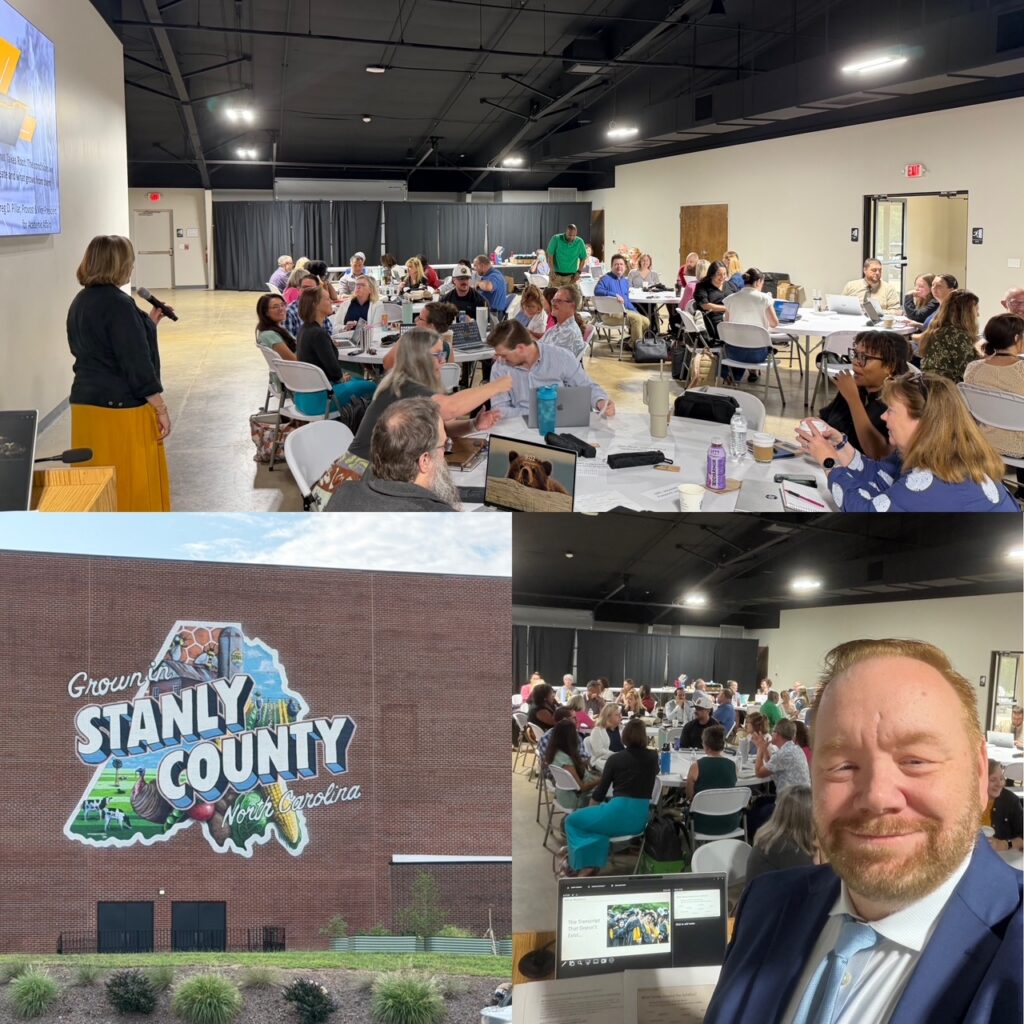
Earlier this week, I had the privilege of delivering the keynote at Pfeiffer University’s Faculty Conference. Faculty Conference is Pfeiffer’s first full gathering of the faculty each academic year, a day focused largely on professional development, shared priorities, and preparation for the semester ahead. Other institutions where I have worked called it Faculty Colloquium or Faculty Assembly, but the purpose is much the same: bringing faculty together to learn, reflect, and begin the year in conversation with one another.
As I prepared, I kept returning to an idea rooted in my earliest academic work. My background is in environmental chemistry through the lenses of agronomy, soil science, and hydrology. These fields teach you to pay close attention to the conditions surrounding growth and to what is happening beneath the surface. In agronomy, much of the work begins long before anything emerges from the soil. You select the seed, prepare the soil, and carefully manage water, nutrients, light, and temperature. You can create conditions that make growth more likely. But planting is not growing. Ultimately, growth belongs to the plant.

Learning works much the same way. Faculty can design thoughtful courses, create meaningful assignments, offer careful feedback, and establish high expectations. An institution can build advising systems, student-support structures, and processes intended to help students navigate college. All of that matters enormously. Yet we cannot make a student learn or grow. Students retain agency and make choices. Our responsibility is to pay close attention to the conditions in which we are asking that growth to happen.
The Discipline of Noticing
President Scott Bullard’s remarks later in the day gave that responsibility a particularly human frame. Drawing from Theo of Golden, he described a character whose most consequential practice is deceptively simple: Theo notices people. He spends time with them, becomes curious about their stories, and refuses to divide the world into people who matter and people who do not. As President Bullard put it, Theo proceeds through life on the assumption that everybody is important.
That idea led President Bullard to pose a compelling possibility: What if Pfeiffer became known as the university that notices people? He reminded us that students need people who notice when they show up, notice when they do not, and care whether they succeed. Strong processes can reduce barriers, but strong relationships give students a reason to stay. He encouraged us to learn names when we can, ask the second question, notice the empty desk, send the email, and tell students we believe they are capable of something before they necessarily believe it themselves.
His remarks connected directly to the question at the center of my keynote: Does what we intend for someone always become what they experience? In my short time at Pfeiffer, one thing has already become unmistakable: our faculty and staff care deeply about students. I hear it in conversations about those who are struggling, and I see it in the pride people take in students’ accomplishments. Dedication is not the question. The more useful question is whether our good intentions are producing the experiences and outcomes we hope they will.
Three Curricula, One Student Experience
One way to examine that question is to recognize that every course contains at least three curricula. The intended curriculum is what we design: the learning outcomes, assignments, readings, activities, and course sequence. The enacted curriculum is what actually happens once the semester begins: what we emphasize, what gets shortened, how we answer a question, and how we respond when students become confused. The experienced curriculum is what the learner actually encounters and the meaning they make from it. Those three curricula overlap, but they are not identical.
An instructor may intend an assignment to develop independence and enact it by giving students room to work through uncertainty. A student may experience the same decision as a lack of direction, perhaps assuming that everyone else understands what to do. None of those accounts has to be dishonest, and a gap between them is not automatically evidence that someone has failed. Learning can and should involve productive struggle. Rigor will not always feel comfortable. The goal is not to remove every difference between intention and experience; it is to notice the difference and become curious about whether it is producing what we intended.
This distinction extends well beyond a single classroom. We experience Pfeiffer in organizational pieces, Academic Affairs, Student Development, Enrollment, Financial Aid, Athletics, the Registrar, Student Success, and the Business Office, but students experience one Pfeiffer. When they receive different answers from different offices, they are unlikely to diagnose a cross-divisional communication problem. They simply experience an institution that does not seem to know. If navigating college requires students to understand the university as well as those of us who work within it, we have made institutional knowledge part of the price of succeeding.
The Transcript That Does Not Exist
During the keynote, I asked faculty to imagine that every Pfeiffer graduate received a second transcript. This one would not list courses, grades, or credit hours. Instead, it would capture everything else we hope takes root because a student spent these years with us. In conversations around the room, faculty named accountability, integrity, personal responsibility, self-knowledge, confidence, connection, resilience, resourcefulness, compassion, belonging, purpose, perseverance, and awareness.
Very few of those qualities belong to one course, and most will never appear as a line on an official transcript. They emerge through the accumulated experience of college: in classrooms and laboratories, advising conversations and office hours, rehearsals and athletic practices, residence halls and dining spaces, moments of achievement and periods of real struggle. Students learn from what we teach, but they also learn from how they experience being here. They learn whether questions are welcomed, whether asking for help is a weakness or a wise practice, whether difficulty means they should persist, and whether they belong.
Two capacities on that unwritten transcript deserve particular attention: curiosity and attention themselves. We want students to ask another question, consider another possibility, and recognize that a first answer may not be the whole answer. But curiosity begins with noticing. It requires enough attention to stay with a difficult idea, listen closely, and see what we might otherwise pass over. In an environment of constant digital distraction, neither capacity can be assumed. We have to cultivate them—and one of the most powerful ways to do that is to model them.
The same capacities also shape how we encounter students. A student misses an assignment, stops attending, or suddenly goes quiet. We can move immediately from behavior to explanation, or we can leave a little room for another question. Curiosity does not eliminate accountability, and attention does not require us to explain away every choice. It simply reminds us that there is a person on the other side of the behavior and that some part of the story may still be hidden from us. Sometimes care means doing something with what we have noticed, including sharing a concern through the Falcon Care Network so that a small observation can become an opportunity for timely support.
Making One Thing More Visible
College contains a substantial hidden curriculum: the unwritten expectations, assumptions, vocabulary, and pathways that experienced insiders take for granted. We know what “come prepared” means in our disciplines. We know what strong work looks like, when a student should ask for help, how to approach a complex assignment, and what “start early” actually requires. Our students may not. Some arrive already fluent in that hidden curriculum; others expend enormous energy trying to decode rules we may not realize we have asked them to follow.
My invitation to faculty was deliberately modest: take one thing that currently lives mostly in your head and make it more visible. Show students what excellent work looks like. Explain when and why to use office hours. Break “get started” into a first concrete action. Identify the step that feels obvious only because we have completed it hundreds of times. Clarity is not the opposite of rigor. Clarity gives more students a genuine opportunity to meet the standard.
The practice I hope we carry into the academic year is equally straightforward: notice what is actually happening, remain curious about what we may not yet understand, and follow the experience from the learner’s side. We will not control every outcome, eliminate every barrier, or see the eventual growth produced by every conversation, assignment, question, or act of attention. That uncertainty is part of the remarkable privilege of education. We plant things whose growth we may never witness.
We cannot make growth happen. But we have enormous influence over the conditions in which we ask it to occur. As a new academic year begins, that leaves us with a question larger than what we plan to cover, assign, assess, or accomplish: What will take root?