
Walking Toward Peace, One Breath at a Time
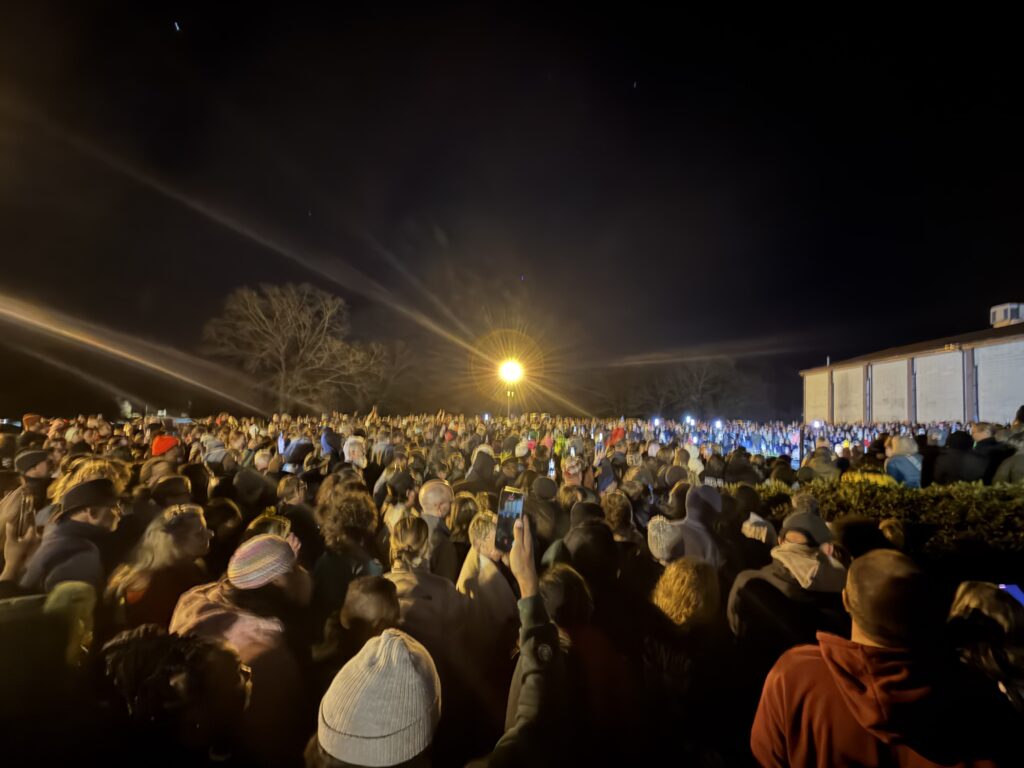
Last night, I attended the Walk for Peace monks’ visitation in South Carolina. What I expected was a moment of quiet reflection. What I experienced was something more enduring.
By the time we arrived at Catawba Baptist Church, where the monks were staying, the crowd was already large and still growing. Due to major traffic congestion, we parked on the side of the road and walked the remaining roughly mile to the venue (what’s a mile to see inspirational souls walking 2,300 miles — some barefoot). We estimated close to 5,000 people over the course of the evening, coming and going between 6:00 and 9:00 p.m. People stood patiently. They waited. They spoke softly. Even before the monks said a word, the space felt different.
The monks themselves are walking from Texas to Washington, D.C., a journey of roughly 2,300 miles. But as they reminded us more than once, that distance, as remarkable as it is, is not the point. “All of us,” one monk said, “are walking to the end of our lives.” The question is not how far we walk, but how we walk.

Peace Begins From Within
The core of their message was simple and repeated often: peace does not begin with systems, structures, or other people. It begins within.
At one point, the monks guided us through a brief mindfulness practice. We were asked to slow our breathing, to pay attention to it, and to give our minds a single job. Count the breath. Notice when your mind wanders. Begin again. Over and over.
Then they asked us to say, together:
“Today is going to be my peaceful day.”
Not as a hope. Not as a wish. As a statement.
They explained that peace is not something others give us or take from us. If someone yells at you, insults you, or speaks with anger, you can choose not to take it. The words still belong to the person who spoke them. Not taking them does not mean escalating, reacting, or pretending harm does not exist. It means not accepting what was never yours to carry in the first place.
That idea stayed with me long after the outdoor space grew quiet again (by the way, when they begin the opening blessing I never heard thousands of people go absolutely silent!).
Walking Without Forcing
One of the most striking things the monks emphasized was what this walk is not.
They are not walking to protest or persuade. They are walking to awaken something that already exists. Peace, they reminded us, does not need to be forced into people. It needs to be remembered.
In a time when almost everything feels urgent, reactive, and loud, their presence offered a different model. Walking without forcing. Speaking without demanding. Inviting reflection rather than compliance.
They were clear that their walking alone does not create peace. But encountering them might remind someone of something they already know but have forgotten. And when that happens, something small but powerful begins. A ripple. One moment of calm. One pause. One choice made differently. That ripple moves outward, quietly, from person to person.
That image stayed with me.
Learning works the same way.
So much of learning, especially for students navigating complex systems, begins not with content, but with conditions. With whether a learner feels overwhelmed or grounded. Seen or invisible. Capable or already defeated.
We often talk about access to higher education, and that matters deeply. But access alone is not enough. Learners also need tools. They need support. They need space to breathe, to pause, to regain their footing when the path feels unclear or unforgiving. Success, completion, and what comes next rarely happen because someone was pushed harder. They happen because someone was supported at the right moment.
A small act of patience.
A moment of clarity.
A reminder that they belong here and can take the next step.
Those moments ripple too.
When we choose not to overload learners with noise, complexity, or unnecessary barriers, we create room for understanding. When we design learning that is accessible, human, and attentive to where students actually are, we are not lowering expectations. We are strengthening the conditions under which learning can take hold and move forward.
Just like the monks’ walk, the impact is rarely immediate or dramatic. It is cumulative. Quiet. Built over time.

Walking Our Own Walk
The monks will continue walking toward Washington. Their journey will end in a visible place, marked on a map. Ours will not.
But every one of us is walking something. Through courses. Through transitions. Through uncertainty. Through growth. Through lives that do not pause just because learning is happening.
The monks reminded us that while we may not be walking barefoot across states, we are still responsible for how we move through the world. How we listen. How we respond. How we choose not to carry what was never ours.
Peace, they said, begins from within. From breath. From attention. From intention.
That may be one of the most important lessons learning can offer, and one of the most important lessons learning can embody.
Not loudly.
Not forcefully.
But steadily, one step at a time.