
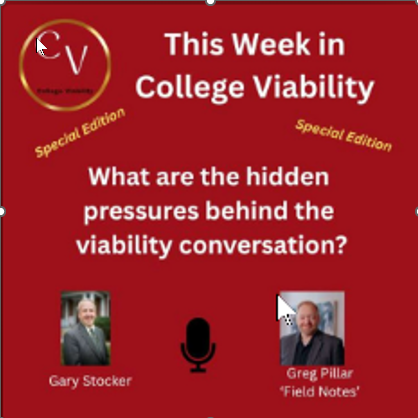
Reflections on My Conversation with Gary Stocker on This Week in College Viability
Being invited onto Gary Stocker’s podcast, This Week in College Viability, was a genuine honor. TWICV was one of the first higher ed podcasts I ever listened to, long before I hosted a show of my own. I admired it for a simple reason. Gary is not afraid to ask the questions many institutions avoid. He speaks directly about financial health, transparency, risk, and the long-term viability of colleges and universities. He also has a rare ability to connect institutional issues to the lived experiences of students and families.
Talking with him felt both energizing and grounding. It reminded me why these conversations are necessary and why they often feel uncomfortable. They point us toward truths we cannot ignore if we want higher education to remain strong and trusted.
What follows is a reflection on the major themes from our conversation and why they matter so much right now.
Why Traditional Metrics Fail to Predict Readiness
Gary opened with a question about GPA and test scores and why they do not accurately predict readiness for the modern college environment. The short answer is that the landscape has changed faster than our metrics. GPA reflects performance in a controlled environment. Test scores reflect how well a student performs on a specific day. Neither provides insight into a student’s ability to manage ambiguity, navigate institutional systems, self-regulate, or ask for help. These are the indicators that now predict success far more reliably than a number on an application. There may have been a time where the GPA reflected controlling an environment that was more in-line with higher ed, but that has long passed. I know K-12 has changed substantially since I was in school, and it isn’t that higher ed hasn’t changed either…it has, but it has perhaps changed in ways that differ from the changes in K-12.
Additionally, our learners have changed, and the overall demographic of our students has changed. The expectations placed on them have changed. The academic and social demands of college have changed. Yet the inputs we use to evaluate readiness have not kept pace. This gap creates a quiet but critical mismatch between who students are and what our systems assume about them.
The Handoff Between Enrollment and Academics
Gary’s next question focused on the transition between enrollment and academics and where students fall through the cracks. He captured a tension that exists on almost every campus. Enrollment celebrates getting students in the door. Academics focus on teaching them once they arrive. In between these two functions is a period of time that often has no clear owner.
The cracks tend to appear during orientation, during the first several weeks of the semester, and in the early moments when students begin to struggle. Students are introduced to information about processes and requirements and even supports, but they are rarely taught how to navigate the cultural, social, emotional, and intellectual shift that college requires. When no one owns the handoff, the student experiences a kind of institutional silence. They do not know who to ask, how to ask, or whether their confusion is normal.
An institution that takes viability seriously must take this transition seriously. A student’s success is shaped most strongly at the moments when they are not yet sure how to make sense of college. This isn’t rocket science (as Dr. Stephen Pruitt, the new President of SACSCOC notes — rocket science is easier) but with the demographic cliff (or slope, or clock, or however you describe it) here…retention and persistence I think will be given a renewed and long overdue focus.
Instructional Capacity and Outdated Infrastructure
Another important point in our conversation was the question of instructional capacity. Gary asked whether we are expecting faculty to do the impossible by placing modern learners into outdated academic infrastructures. The honest answer is yes. Many institutions have not adjusted advising models, classroom structures, teaching loads, digital expectations, or student support systems to match the complexity of today’s learners. While faculty are not the only ones experiencing burn-out, some of that burnout is coming from the perceived sudden expectations and responsibilities. Please do NOT mistake this for an argument about rigor or student responsibility. Not at all… however, there are numerous mismatches in expectations of students, faculty and even the expectations that society has placed on higher ed.
Students arrive with more variation in preparation, more financial strain, more personal responsibilities, and more questions about purpose and direction. Yet faculty are often expected to meet these needs within structures that were designed for a different era.
Instructional capacity is not only an academic concern. It is central to financial viability. When faculty are stretched beyond what is reasonable, the student experience deteriorates. When the student experience deteriorates, retention follows. This has clear financial consequences that cannot be ignored.
The Nuance Behind Program Cuts
We also discussed how media outlets frame program reductions as a conflict between faculty and administration. This framing misses the deeper truth that institutions often built their academic portfolios for a demographic and economic reality that no longer exists. Many colleges are still operating with program arrays created decades ago. Students and labor markets have shifted, yet academic structures have remained static (if you haven’t already — definitely read Rosenberg’s Whatever It Is I’m Against It.).
Program adjustments are almost never about choosing sides. They are about choosing sustainability. They are about honoring the mission by ensuring it can continue. Cuts are painful, but they reflect the tension between mission and financial reality, not a simple disagreement between two groups.
The Moral Obligation to Admit Only Those You Can Support
Gary asked one of the hardest questions of the episode. Should colleges stop enrolling students they are not structurally prepared to graduate? I believe they should. When a college admits a student, in my view, it makes a promise. That promise includes more than access. It includes the support, resources, pathways, and structures required to help the student complete a degree. Again…this is not saying that a school should not maintain a high level of rigor. Rather, it is more about how you are bringing that student along to navigate and develop in that level of rigor.
If an institution does not have adequate advising, financial aid clarity, academic support, and instructional capacity, then enrolling a student is not an act of opportunity. It is an act of risk. Students deserve honesty about the environment they are entering. Viability is not only about institutional survival. It is about institutional responsibility.
The Tuition Mirage
Our conversation also touched on what I’ve noted as the tuition mirage. Published tuition is not the price families pay, and it is not the revenue colleges receive. Students hear the word scholarship and assume they are receiving a financial award. Institutions know they are often offering deep discounts that conceal financial fragility. I’ve covered in my newsletter how the discount rate has increased over the years and the average discount rate is in the 50-60% range. Some schools have discount rates as high as the 70-80%. This is tough to sustain!
Transparency in this area is essential. Understanding how tuition, discount rates, aid packages, and debt interact is central to any honest conversation about financial health.
The AI Question
Gary ended by asking about a scenario in which AI becomes a better teacher than human instructors. It is possible that AI will outperform humans on certain tasks such as explanation, personalization, or assessment. What AI cannot replicate is the relational dimension of teaching. Students learn through trust, presence, motivation, identity formation, and mentorship. None of these are programmable. In cases where institutions or individuals maintain a transactional approach, that is where you will see AI performing better than some instructors. But I do believe that faculty (and institutions) will rise to the challenge and evolve as educators!
Institutions that thrive in an AI rich future will not compete with AI. They will leverage AI for efficiency and invest heavily in relationships, design, human connection, and the environments that support belonging.
Why Gary’s Work Matters
Gary’s work through TWICV and the College Financial Health Show fills a gap in higher education. He and Matt Hendricks make financial health understandable for the people who matter the most. Students. Families. Faculty. Trustees. Communities. They provide the transparency that too many institutions avoid. Their tools and commentary help stakeholders make informed decisions about colleges and about the risks they may not see.
Being on TWICV reminded me that higher education needs more voices willing to speak plainly. We need more people willing to ask what viability requires and what responsibility demands.
Final Reflection
I left the conversation grateful for the opportunity and also grateful for the clarity that Gary brings to the field. Higher education is entering a defining period. The pressures are real, but so are the opportunities to reimagine how we serve students, how we structure institutions, and how we communicate truthfully about our capacity.
Viability is not simply about survival. It is about honoring the trust students place in us. It is about ensuring that the promises we make are promises we can keep.