
Part 2 – Available now – Episode 20 (Season 2): The Real Value of a Liberal Arts Education with Dr. Robert Prickett (Part 2)
Have We Been Asking the Wrong Question About College?
At this time of year, the question shows up almost everywhere. Students are finishing finals, families are gathering, and graduates are preparing to walk across the stage. In those moments, celebration quickly gives way to reflection, and one question tends to surface more than any other. Was it worth it?
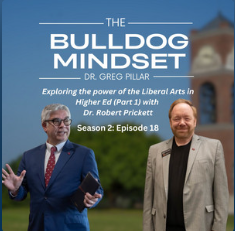
It is a fair question, and it deserves an honest answer. But in Part 1 of my recent 2 part conversation on The Bulldog Mindset with Dr. Robert Prickett, Dean of the College of Arts and Sciences, we spent less time trying to answer that question directly and more time stepping back to examine how we are asking it in the first place. Because what became clear early in the conversation is that the way we frame the value of college, especially the liberal arts, often misses what actually matters.
Most conversations about college value follow a predictable path. We ask what major a student chooses, what job that major leads to, and whether the return justifies the cost. That model feels practical, but it flattens the experience into something far narrower than what students actually gain. As Dr. Prickett noted during the conversation, the major itself can become secondary when you consider the broader set of skills and habits students develop along the way.
What carries forward are not just content areas, but ways of thinking and working. Students learn how to analyze complex problems, communicate clearly, adapt when circumstances shift, and make connections across different domains of knowledge. These are not abstract ideas. They are the same qualities employers consistently say they value, even if they are not always framed in those terms during hiring conversations.
Part of the challenge is that the phrase “liberal arts” itself has become a point of tension. For some, it represents intellectual curiosity and a broad foundation. For others, it raises concerns about direction or job outcomes. That divide does not exist because the value is unclear. It exists because the story has not been told well or consistently. Dr. Prickett was direct about this. Higher education has not always been its own best advocate in explaining what a liberal arts education actually provides.
At the same time, the misunderstanding is not only about messaging. It is also about expectations. Many people still approach college as if it should map cleanly to a single career path, when the reality is far more complex. Graduates are likely to move across multiple roles and even multiple fields over time. In that context, the ability to think critically, communicate effectively, and adapt becomes more valuable than a narrow alignment between major and first job.
This becomes even more important when you consider the kinds of problems graduates are stepping into. Issues like artificial intelligence, climate change, and global economic shifts do not belong to a single discipline. They require people who can connect ideas, work across boundaries, and approach challenges from multiple perspectives. A liberal arts foundation, at its best, prepares students to do exactly that.
One of the most meaningful parts of the conversation came when we shifted to what we call the “hidden curriculum.” This is the part of college that does not show up in course catalogs or program requirements but often shapes students just as much as their classes. Dr. Prickett described it not as a specific skill or outcome, but as an accumulation of experiences.
Students attend events, engage in conversations, build relationships, and encounter ideas that expand how they see the world. They take part in opportunities that challenge them to step outside of their comfort zone and engage with people and perspectives that are different from their own. Over time, those experiences create what he described as an “overlay of human experience,” something that is difficult to quantify but deeply influential in how students grow and develop.
This is where the conversation about value becomes more complicated. It is easy to point to a degree or a first job as evidence of success. It is much harder to measure how a student’s ability to think, communicate, and navigate complexity evolves over time. Careers are rarely linear, and the impact of a broad education often becomes clearer several years after graduation rather than immediately at the start.
That does not mean the concerns about cost and outcomes are misplaced. They are real, and they deserve attention. But if we focus only on what can be easily measured in the short term, we risk overlooking the aspects of education that matter most in the long term. The tension is not between value and skepticism. It is between how quickly we expect that value to reveal itself.
What stood out to me most in Part 1 is how often we return to the same narrow frame when discussing college. We ask what students study and what job they get, but we spend far less time asking how they have changed as thinkers, problem solvers, and individuals. A college education, especially within the liberal arts, is not just about acquiring knowledge. It is about developing the capacity to use that knowledge in ways that extend beyond a single context.
What stood out to me most in Part 1 is how often we return to the same narrow frame when discussing college. We ask what students study and what job they get, but we spend far less time asking how they have changed as thinkers, problem solvers, and individuals. A college education, especially within the liberal arts, is not just about acquiring knowledge. It is about developing the capacity to use that knowledge in ways that extend beyond a single context.
That shift in perspective is where this conversation starts, not where it ends. In Part 2, we move from reframing the question to applying it more directly. We will look at what this means for students trying to make sense of their experience, how they talk about its value, and what institutions need to do differently if they want that message to land.
For now, it is worth sitting with a different version of that familiar question. Instead of asking only whether it was worth it, a better place to start may be asking what this experience made possible that would not have been possible otherwise.