
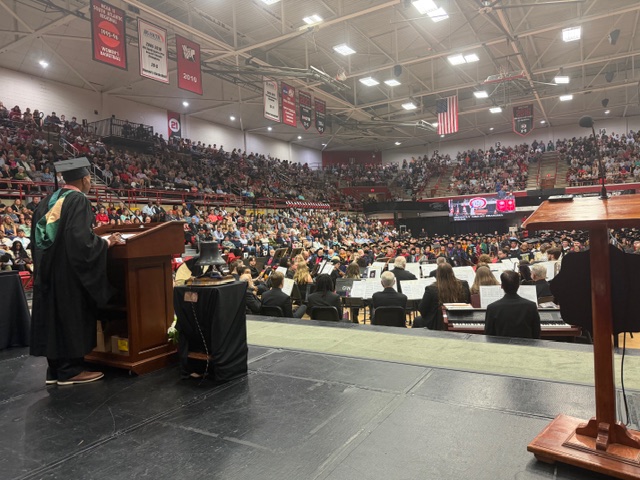
Commencement speeches are difficult to get right. After attending more than 30 commencements over the years, I can say many begin to blend together. Too often, they become predictable and formulaic. Graduates are told to “go change the world,” to “dream big,” to “never stop believing in yourself,” or that they are “the future.” None of those messages are inherently wrong. The problem is that many speeches stay at the surface level. They offer inspiration without much reflection, challenge without much substance, or encouragement without acknowledging the complexity of the world graduates are entering.
Patrick Woody’s commencement address at Gardner-Webb this spring avoided that trap entirely.
Woody, a 2003 Gardner-Webb graduate and former Student Government Association president, returned to campus with a story that already carried weight before he even stepped to the podium. After graduating with a degree in history and political science, he worked in the nonprofit and civic education sectors before entering the Department of Homeland Security as an analyst. That path eventually led him into the National Counterterrorism Center, the CIA, and later into briefing senior White House officials, Cabinet members, and multiple U.S. presidents on national security issues. He became known for his work surrounding online extremism, intelligence analysis, and cybersecurity, eventually serving as a regular intelligence briefer at the highest levels of government across multiple presidential administrations.
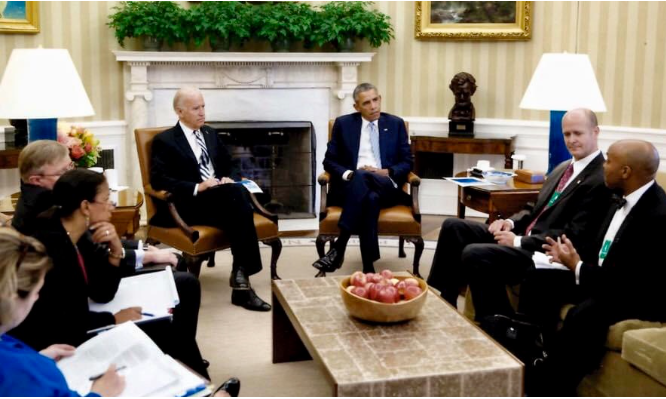
Gardner-Webb University alumni Patrick Woody 03′, provides a security briefing to President Obama, Vice President Biden, and staff. (Photo courtesy Pete Souza)
What made his speech compelling, though, was not the résumé itself. It was the way he connected experience, humility, failure, reflection, and growth into something graduates could actually carry with them beyond the ceremony.
His message centered around one word: “F.I.R.E.D.”
Woody explained that graduates needed to get fired, not from a job, but from the mindset that graduation means they have arrived. The framework stood for failure, investment, reflection, education, and dialogue. On the surface, it sounds simple. In practice, it addressed many of the exact tensions students and young professionals are facing right now.
The section on failure was especially strong because it pushed directly against the way many students have been conditioned to think about achievement. Woody described failure as data. He challenged graduates to stop seeing failure as identity and instead see it as information, feedback, and redirection. That distinction matters because higher education environments can unintentionally train students to believe every setback is permanent. Grades, scholarships, internships, admissions decisions, and leadership opportunities often create pressure to perform continuously and flawlessly.
Then graduates enter the real world and quickly realize that careers rarely unfold in perfectly straight lines.
Woody did not speak about failure as an abstract concept. He shared his own experience of being laid off roughly a year ago and wrestling with whether that moment defined him personally. Instead of treating the event as proof of inadequacy, he reframed it as a push toward something he already felt called to pursue. That honesty changed the tone of the room. It felt less like a carefully polished commencement script and more like someone offering hard-earned perspective.
The reflection component of his framework also stayed with me long after the ceremonies ended. Woody talked about conducting what he called a personal “State of the Union” twice a year, intentionally evaluating where his life is headed and whether he is still moving in the right direction. In a culture dominated by speed, constant stimulation, notifications, and performative busyness, that idea felt unusually grounded.
People move quickly from task to task, achievement to achievement, and crisis to crisis without ever stopping long enough to ask whether they are becoming the kind of person they actually want to become. Universities are not immune from this either. Higher education often operates in a constant state of reaction to enrollment concerns, budget pressures, rankings, technological disruption, political tension, and public scrutiny. Reflection becomes secondary because urgency always feels louder.
Yet reflection is often what keeps people from drifting aimlessly through their own success.
His discussion of dialogue may have been the most timely part of the speech. Woody encouraged graduates to seek out people with different beliefs, backgrounds, and perspectives, not for debate or performance, but for understanding. That message carried additional credibility because it aligned closely with both his professional career and his earlier experiences as a student. During his time at Gardner-Webb, he participated in and co-hosted political discussions designed to encourage conversation across ideological differences. Later, his work required him to brief presidents and senior officials whose political views did not always align with his own.
That experience clearly shaped the way he thinks about leadership and communication.
At a time when public discourse often rewards outrage, certainty, and tribalism, his call for thoughtful dialogue felt refreshingly direct. He reminded graduates that understanding another person’s worldview does not require abandoning your own convictions. It does require humility, curiosity, and the willingness to listen before immediately trying to win.
There was also something important about the structure of the speech itself. Woody covered a remarkable amount of ground in a relatively short period of time without sounding rushed or scattered. The framework gave the speech clarity, but the substance beneath each letter gave it depth. He spoke about mental wellness, investing in relationships, continuing education in the age of AI, financial literacy, mentorship, purpose, and civic engagement. Yet none of it felt overloaded or artificially stitched together.
The speech worked because it felt connected to real life.
Too many commencement speeches operate as if graduates are stepping into a stable and predictable future. Woody acknowledged something far more honest. Today’s graduates are entering a world shaped by rapid technological change, political polarization, economic uncertainty, and constant reinvention. In that environment, adaptability matters. Reflection matters. The ability to learn continuously matters. The ability to recover from setbacks matters. The ability to communicate across difference matters.
His framework recognized all of that without becoming cynical or pessimistic.
By the end of the ceremony, what lingered was not a single inspirational quote or viral one-liner. It was the larger challenge embedded throughout the speech: do not confuse accomplishment with completion. Graduation is an important milestone, but it is not the moment where growth stops. If anything, it is the point where graduates are expected to take ownership of that growth themselves.
Of the 30-plus commencement ceremonies I have attended over the years, this one absolutely stands out and easily ranks among the top five. Part of that was the clarity of the F.I.R.E.D. framework itself. Part of it was Woody’s ability to cover so many meaningful themes succinctly, directly, and authentically without sounding rehearsed or performative. Mostly, though, it was because the speech respected the intelligence and reality of the audience. It challenged graduates honestly while still leaving them encouraged about the future ahead. In many ways, it reflected the same responsibility Woody carried throughout his professional career briefing presidents, Cabinet members, and senior officials. His job was not to simply tell powerful people what they wanted to hear. It was to deliver the message they needed to hear, whether it was comfortable, politically convenient, or fully agreed with in the moment. This commencement speech carried that same quality. It did not rely on empty reassurance or polished clichés. It trusted graduates enough to give them honesty, complexity, and a framework that acknowledged both the opportunities and the difficulties waiting ahead.