
The Next Accreditation Battleground May Not Be Colleges at All
For decades, accreditation conversations have largely revolved around colleges, universities, degrees, federal financial aid, governance structures, institutional oversight, and the machinery of traditional higher education. Even when leaders debated whether accreditation had become too bureaucratic, too political, too expensive, or too disconnected from outcomes, the overall ecosystem still felt relatively stable. Most people understood the broad framework. Institutions sought accreditation. Accreditors reviewed institutions. Degrees carried legitimacy because recognized systems stood behind them. While disagreements certainly existed, the underlying structure itself remained mostly intact.
That stability is beginning to fracture, and the reasons extend far beyond politics or regulation. A growing amount of learning is now taking place outside traditional degree pathways altogether. Workforce credentials, employer-sponsored training, executive coaching programs, boot camps, continuing education divisions, industry certifications, online microcredentials, and non-credit professional development have created what some are starting to describe as a “third sector” of education. It exists somewhere between traditional higher education and direct workforce training, often operating outside many of the structures that have historically defined academic quality, institutional accountability, and public trust.
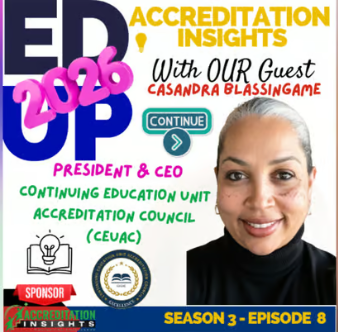
That emerging space became the focus of a recent episode of Accreditation Insights, where I had the opportunity to join Laurie Shanderson and Leamor Kahanov in a conversation with Casandra Blassingame, President and CEO of the Continuing Education Unit Accreditation Council (CEUAC). The discussion centered on a deceptively simple question that higher education is going to be forced to answer much more directly over the next decade: as learning increasingly moves beyond the traditional degree model, who determines quality, credibility, and trust?
What made the conversation compelling was not that we arrived at clean answers. In many ways, the uncertainty surrounding the discussion was precisely the point. Higher education is entering territory where existing accreditation systems, workforce demands, employer expectations, and alternative learning models are beginning to overlap in ways that remain deeply unsettled.
Blassingame’s own career trajectory reflects many of those shifts. She began working in higher education through short-term workforce programs before moving through community colleges, HBCUs, university continuing education divisions, associations, and workforce development organizations. Eventually, that path led her into accreditation work connected specifically to continuing education and professional learning environments. Listening to her describe that progression, it became clear how blurred the boundaries between higher education, workforce preparation, and lifelong learning have become. What once felt like separate ecosystems increasingly operate in overlapping territory, often serving the same learners through different structures and credentials.
That blurring creates opportunities, but it also creates confusion. One of the recurring themes throughout the episode involved the awkward position continuing education often occupies inside traditional colleges and universities themselves. Many faculty members and academic units still possess limited familiarity with non-credit instruction, workforce-aligned programming, employer partnerships, or adult professional learning models. Blassingame discussed encountering this firsthand while trying to build credibility for continuing education units within four-year institutions. In many cases, those divisions operated adjacent to the academic core without ever being fully integrated into institutional identity or long-term strategy.
That disconnect matters far more today than it may have twenty years ago because continuing education is no longer sitting quietly at the margins of institutional planning. For many tuition-dependent colleges and universities facing demographic decline, enrollment pressure, and growing financial strain, continuing education and workforce partnerships are increasingly viewed as potential growth engines. Adult learners, stackable credentials, employer-aligned certificates, and upskilling programs now appear regularly in conversations about institutional sustainability and future positioning. What once felt supplemental has started moving much closer to the center.
Yet accreditation systems have not fully adapted to that shift. Traditional institutional accreditors primarily focus on degree-granting institutions. Programmatic accreditors evaluate specific disciplines and professions. Large portions of the rapidly expanding non-credit ecosystem, however, often fall outside those structures entirely. That gap is part of what organizations like CEUAC are attempting to address.
At the same time, the episode highlighted just how unsettled and ambiguous this space still is. One of the central tensions throughout our conversation involved the question of value. What exactly does accreditation mean in a continuing education environment where federal financial aid frequently does not apply? If these programs are not functioning inside the same Title IV ecosystem as traditional higher education, then where does legitimacy come from? Is accreditation in this space primarily about quality assurance? Employer confidence? Market signaling? Consumer trust? Grant competitiveness? Regulatory positioning? Some combination of all of them?
The answer often seemed to drift toward “all of the above,” which may itself reveal part of the challenge. Traditional accreditation at least operates within a relatively understood framework tied to institutional recognition, transferability, financial aid eligibility, and degree legitimacy. The continuing education space is much more fragmented. Different providers serve different purposes, different audiences, and different industries. Some programs focus on workforce advancement. Others support professional licensure maintenance. Others operate more like coaching or personal development enterprises. Trying to create consistent definitions of quality across that landscape becomes significantly more difficult.
There was also an undercurrent throughout the discussion that many institutions are still wrestling with whether this emerging credential ecosystem should be viewed primarily as a complement to higher education or as a competitor to it. Some workforce-oriented credentials clearly address legitimate needs and create valuable access points for adult learners or working professionals who may not need or want full degree programs. Others provide flexible and affordable pathways for highly specific professional competencies tied directly to workforce demand.
At the same time, there is also legitimate concern about what happens when the language of accreditation and quality assurance becomes increasingly detached from commonly understood standards. Even within traditional higher education, accreditation remains poorly understood by much of the public. Many students and families already struggle to distinguish between institutional accreditation, programmatic accreditation, state approval, licensure requirements, and various forms of certification. Expanding the ecosystem into non-credit and workforce spaces only increases that complexity. The more fragmented the landscape becomes, the harder it may become for learners to distinguish meaningful quality from marketing language.
What I found particularly interesting was how closely this entire conversation mirrored broader tensions already unfolding across higher education itself. Questions surrounding value, workforce alignment, return on investment, employer expectations, alternative credentialing, and educational relevance are no longer peripheral conversations. They are central conversations shaping institutional strategy, public perception, enrollment planning, and political scrutiny. Colleges and universities are under increasing pressure to demonstrate economic relevance while simultaneously preserving broader educational missions tied to citizenship, leadership, critical thinking, intellectual growth, and human development.
That balancing act becomes increasingly difficult when the educational marketplace itself grows more fragmented and decentralized. Accreditation has historically functioned, at least in part, as a proxy for public trust. It signals that an institution or program has met some agreed-upon threshold of quality, oversight, and accountability. But when new forms of learning emerge faster than traditional systems can adapt, new organizations inevitably step forward to fill those spaces. The real question is whether those emerging structures ultimately strengthen educational ecosystems or further complicate them.
To be clear, I do not think the answer is simply dismissing continuing education accreditation efforts outright. That would ignore the very real transformations happening across workforce development, adult learning, and professional education. There are legitimate reasons organizations, employers, and learners may seek validation, external review, and quality frameworks surrounding professional learning programs. The demand itself is real, particularly as employers place greater emphasis on skills, competencies, shorter-term credentials, and workforce agility.
What remains far less clear is where all of this ultimately leads. Will we eventually see a parallel accreditation ecosystem emerge entirely outside traditional higher education? Will employers increasingly prioritize validated competencies over degrees in certain sectors? Will colleges and universities successfully integrate these models into their own institutional structures, or will entirely separate credentialing ecosystems continue to expand alongside them? And perhaps most importantly, how will learners navigate a marketplace where educational legitimacy becomes increasingly difficult to interpret?
Those questions are no longer theoretical. They are already shaping enrollment strategy, workforce partnerships, adult learner engagement, institutional growth planning, and broader conversations about the future of higher education itself.
What made this episode of Accreditation Insights particularly valuable was not that it resolved those tensions. It exposed how early higher education still is in fully understanding where continuing education, workforce learning, credentialing, and accreditation are headed over the next decade. In many ways, the uncertainty surrounding these issues may be the clearest indication that higher education is entering a very different phase of its evolution.