
Knowing Our Students Is a Starting Point. What We Do Next Matters.
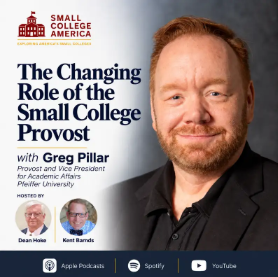
Reflections on my conversation with Small College America about academic leadership, student pathways, and the changing role of the small college provost.
My doctoral research examined what happens when explosive compounds (such as TNT, RDX, HMX) gets into soil. Naturally, Dean Hoke saw an opportunity to ask how that prepared me to become a provost.
There are probably several answers to that question, some more suitable for a podcast than others.
I recently joined Dean and co-host W. Kent Barnds on Small College America for a conversation about my journey from environmental chemistry to academic leadership and my first months as Provost and Vice President for Academic Affairs at Pfeiffer University. We talked about the changing responsibilities of the provost, the relationship between academic quality and institutional sustainability, and the opportunities ahead for small colleges.
One question from our conversation has stayed with me:
When we say we know our students, what do we do with what we know?
Small colleges often describe themselves through personal attention, close relationships, and small classes. Those qualities matter. I have spent my career at institutions where faculty and staff know students by name and take a personal interest in their success.
But knowing a student is a starting point. The value of that relationship becomes clearer in what happens next.
Can we recognize when a student needs support and respond while there is still time to help? Can we explain how previous college credit applies to a degree? Can we offer a course schedule that makes completing that degree possible? Can we help students see how their education connects to the lives they hope to build? Can we help in launching their next steps post-graduation?
Those questions bring the promise of a small college into the everyday experience of attending one.
A Scientist’s Approach to Leadership
My move into administration happened through a succession of opportunities to serve: department chair, honors program director, and academic affairs roles that included a considerable collection of interim responsibilities.
Over time, I realized that I could help remove obstacles affecting students and faculty well beyond my own classroom. That possibility drew me further into academic leadership and has kept me here.
My scientific training remains part of how I approach the work. I want to understand what is happening, test my assumptions, and pay attention when the evidence challenges my first explanation.
That last part takes discipline. An explanation can feel convincing before we have asked enough questions. A familiar practice can appear necessary because we have used it for years. Listening carefully to students, faculty, and staff helps reveal where our understanding is incomplete.
So does being willing to revise it.
Academic Decisions Carry Institutional Consequences
During the interview, Dean asked what had surprised me about becoming a first-time provost.
My previous roles gave me considerable exposure to the work. Still, there is a difference between participating in a decision and carrying responsibility for its direction and consequences.
One early observation has been how quickly an academic decision becomes an institutional decision.
A course schedule affects students’ progress toward graduation. A faculty position carries implications for academic quality, workload, program capacity, and finances. A new program requires conversations about demand, recruitment, staffing, student support, and the resources needed to deliver it well.
The provost’s responsibility for academic quality therefore requires a broad understanding of the institution and close working relationships with colleagues throughout it. Enrollment, finance, student affairs, technology, and academic affairs each hold information the others need.
At a small college, those connections are particularly consequential. Our decisions travel quickly through the institution, and students experience the results.
Sustainability Is Part of the Educational Promise
We also discussed accreditation, which has been a significant part of my work at multiple institutions.
Serving as an accreditation liaison teaches you a great deal about how a university functions. It requires looking across departments and divisions to examine whether the institution can demonstrate that it is doing what it says it does.
That perspective informs how I think about financial sustainability.
Students rely on a college’s ability to deliver the education it promises through to graduation. Financial health affects the availability of courses, the continuity of faculty and staff, and the support students can access along the way.
For that reason, academic planning and financial planning need to credibly support each other. A compelling academic vision needs the resources to carry it forward. Financial decisions need a clear understanding of their educational consequences.
Asking difficult questions about that relationship is part of our responsibility to students.
Clearer Paths Through College, and Back to It
When Kent and Dean asked about the future of small colleges, I offered a prediction with the appropriate acknowledgment that my crystal ball came without a warranty.
I believe successful small colleges will make personal attention more visible in how students actually move through the institution.
That includes clearer pathways for students entering directly from high school, transferring from another institution, or returning with previous credit and years of experience. It also means being prepared to welcome people back later, when a career change or a new responsibility creates a reason to continue learning.
Students’ lives do not always follow the sequence our institutions were designed around. An eighteen-year-old may be balancing work and family obligations. An adult returning to college may need help understanding whether finishing is financially and practically possible.
We need to understand those circumstances well enough to design workable paths.
That does require choices. Each college needs to understand whom it can serve well, what it can sustain, and where its strengths meet a real need.
At Pfeiffer, I see considerable opportunity in the combination of our rural setting, liberal arts foundation, professional programs, and faculty and staff who know this university and its surrounding communities deeply. Their knowledge and commitment give us something substantial to build upon.
The work ahead is to turn that understanding into clearer opportunities for the students we serve.
I am grateful to Dean Hoke and W. Kent Barnds for the invitation and for a conversation that gave me room to reflect on these questions early in my time as provost.
Listen to “The Changing Role of the Small College Provost” on Small College America. The episode is also available on Apple Podcasts, Spotify, and YouTube.