
Author’s Note:
This post is part of Fault Lines for 2026, a series examining areas where pressure has been building quietly across higher education and where 2026 is likely to make that pressure increasingly visible. Each post explores one fault line in depth. Together, they offer a broader view of the structural forces reshaping the sector and what those shifts demand of institutions going forward. For a general introduction to the series, see the opening post, and explore the other fault lines for 2026 to see how these dynamics connect.
Fault Line #6 – College for All
For decades, “college for all” operated as an organizing principle in American higher education. It shaped enrollment strategies, academic calendars, advising models, financial aid timing, and public messaging. The assumption was not just that college should be widely accessible, but that it should occur at a specific moment, immediately after high school, full time, and front-loaded for a single career trajectory.
That assumption no longer holds.
This is not a retreat from access. It is a recalibration of timing.
In 2026, the institutions best positioned to endure will be those that recognize a harder truth: college is not for everyone right now, but it remains relevant for most people at some point. When access is framed as time-bound, institutions overbuild for a shrinking population and under-serve the learners who return later. When access is reframed as life-course-based, higher education regains relevance without forcing immediacy.
This reframing aligns closely with what many have begun to describe as the modern learner, a term that surfaced repeatedly throughout 2025 and reflects a fundamental shift in who students are and how learning fits into their lives. As Mark David Milliron has noted in his work and recent conversations on the EdUp Experience podcast, roughly 70 percent of today’s college students are “ANDers.” They are students and parents. Students and employees. Students and caregivers. Students and members of the military. They are not giving up these roles to attend school. They are navigating education alongside them.
The learner landscape already reflects this reality.
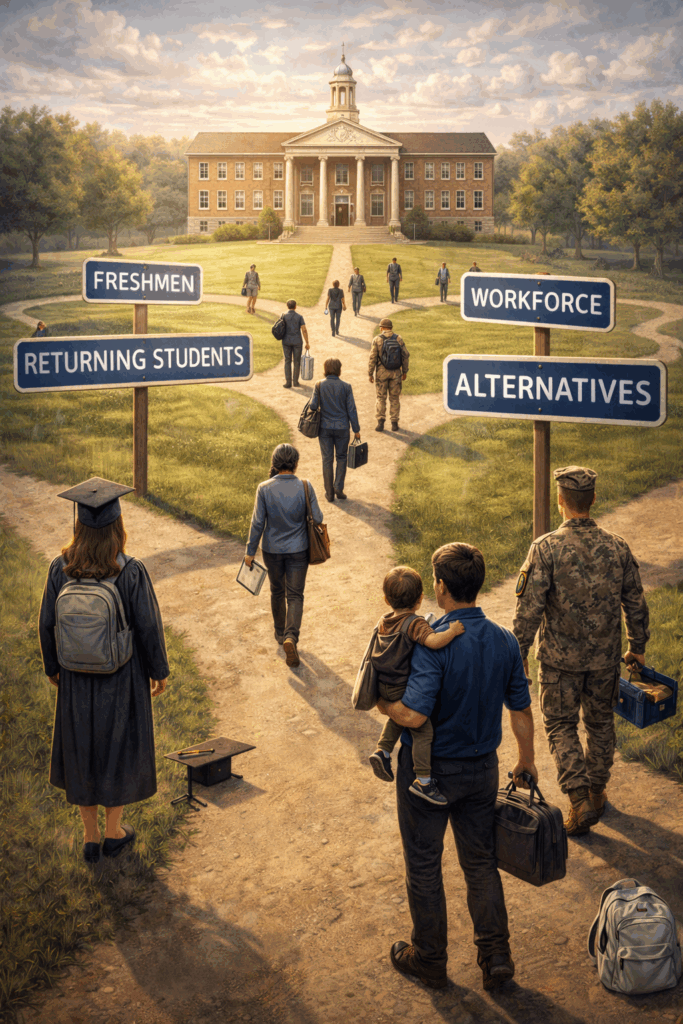
Many students now delay college after high school, pursue alternatives, or enter the workforce directly. Others begin at community colleges, pause for family or financial reasons, or leave without a credential. A growing number return after ten, twenty, or thirty years, sometimes with prior credit, sometimes with none, but often with substantial professional experience. These learners are not exceptions. They are becoming the norm.
Seen through the lens of the ANDer (or the term I’ve been using/adopting, the “Modern Learner”), this pattern is not a failure of aspiration. It is a mismatch between institutional design and lived reality.
Students are not abandoning education. They are refusing to choose between learning and life.
Institutions that continue to design programs, policies, and services primarily around the traditional eighteen-to-twenty-two-year-old experience implicitly force that choice. Those that build for entry, exit, and reentry across age, experience, and starting point create space for learners whose lives do not pause for schooling.
This reframing shifts what success looks like.
Instead of asking how to funnel more students directly from high school into full-time enrollment, institutions begin asking how to remain accessible across life stages. Pathways are designed to accommodate high school graduates, transfer students, adult learners, veterans, and individuals with significant workforce experience. Credentials are stackable, a theme explored earlier in the discussion of short-term credentials. Credit for prior learning is treated as infrastructure rather than exception. Advising recognizes stop-and-start progress as normal rather than deficient. These shifts also intersect directly with earlier fault lines around enrollment strategy, retention, and institutional trust.
For ANDers, this matters deeply. As Milliron has observed, these learners often do not come seeking a degree as an abstract goal. They come to change their lives. The degree is the tool, not the purpose. When systems are rigid, progress stalls. When pathways are coherent, flexible, and transparent, momentum becomes possible.
Importantly, this shift does not guarantee success. But without it, success becomes far less likely.
Institutions that embrace a genuine lifelong-learning posture gain multiple points of connection. They create value not just at admission, but at return. They become places learners can come back to, to upskill, pivot careers, advance professionally, or complete what was once out of reach. Over time, this posture becomes a trust signal in itself, reinforcing themes discussed earlier around credibility and alignment between institutional claims and lived experience. It also has implications for workload and capacity, since supporting learners across life stages requires intentional design rather than add-on labor.
The alternative is quiet irrelevance.
Institutions that cling to a time-bound access model will continue competing intensely for a shrinking pool while leaving growing populations underserved. They may preserve tradition, but at the cost of adaptability.
What This Signals
In 2026, access is no longer defined by immediacy.
The deeper signal is that “college for all” survives not as a single entry point, but as a lifelong option. Institutions are being pushed to move beyond binary thinking that divides students into traditional and nontraditional categories. Instead, learners are increasingly understood by timing, context, and life circumstance, not age alone.
This shift connects directly to the other fault lines already described. Enrollment strategies that ignore life-course access struggle to keep pace with reality. Credential ecosystems that lack reentry points fail to convert interest into completion. Retention efforts that assume linear progress miss the needs of stop-and-start learners. Trust erodes when institutions promise openness but design systems that only work for a narrow slice of students.
The institutions that adapt will redesign around flexibility, return pathways, and coherence across a learner’s lifetime. They will treat reentry as normal, prior learning as valuable, and timing as variable. In doing so, they expand relevance without lowering expectations.
Those that do not will find that access in name only is no longer sufficient. In 2026 and beyond, the question is not whether institutions claim to serve everyone. It is whether they are built to serve people when they are actually ready, willing, and able to learn.
NOTE: Images in this series were generated using AI and are intended as symbolic representations of each fault line.