
Every once in a while, a conversation reminds you what college is supposed to be.
Not just classes. Not just assignments. Not just checking boxes on the way to a degree. But the kind of experience where a student starts to take ownership of their learning and follows it somewhere meaningful.
This episode of The Bulldog Mindset with Bethany Durham and Dr. Elizabeth Amato is one of those conversations.
Bethany is a junior majoring in political science and international relations, with minors in sociology and French, and she currently serves as Student Government Association Vice President. That alone would make for a strong profile. What stood out, though, was not the list of roles or accomplishments. It was how her story unfolded and how she approached her education along the way.
Like many students, she did not arrive with everything figured out. Her interests sharpened over time. COVID became a turning point, sparking a deeper interest in politics, human rights, and the broader questions shaping society. What began as curiosity slowly turned into something more intentional. She moved from learning about topics to engaging with them, questioning them, and eventually contributing to them.
That shift is where things start to change for students.
Following a Question That Didn’t Have an Easy Answer
Bethany’s research focused on women as perpetrators of genocide, using Rwanda as her case study. It is not a common angle, and it is certainly not a comfortable topic. What makes the story compelling is how she arrived there.
She already had an interest in Rwanda, but when she started digging deeper, she realized that much of the existing work focused on familiar narratives. When she tried to find research on women as perpetrators, there was very little available.
For many students, that might have been a stopping point. Instead, it became the reason to keep going.
As Dr. Amato explained, not finding existing research is often the most promising sign. It means there is space to ask a new question and contribute something that has not been fully explored. Bethany leaned into that uncertainty. She read extensively, followed sources, worked through gaps, and built her understanding piece by piece.
By the time she presented her work at a conference, something had shifted. She was no longer just learning about a subject. She was part of the conversation. That realization, more than the presentation itself, is what stays with students.
Connecting Academic Work to Real Experience
At the same time, Bethany was navigating a congressional internship, which offered a very different kind of learning.
Research demanded patience, deep reading, and the ability to sit with complex ideas. The internship required her to respond quickly, communicate clearly, and operate in a fast-moving environment where expectations are not always spelled out. Both experiences stretched her, just in different ways.
There were moments where things did not go smoothly. That is part of the process. What stood out was how she reflected on it afterward. If she could go back to her first day, her advice would not be about mastering every detail or getting everything right. It would be much simpler. It is okay to make mistakes, and it is okay to learn as you go.
That perspective is hard-earned, and it is one that applies well beyond a single internship.
The Mentorship That Makes It Possible
Experiences like this rarely happen without strong mentorship, and that dynamic came through clearly in the conversation.
Dr. Amato described her role not as directing Bethany’s work step by step, but as helping her navigate the process. At a certain point, the student begins to take the lead. The mentor becomes a guide rather than an instructor. That shift is subtle, but it matters. It signals that the student is developing confidence, ownership, and the ability to think independently.
It also reinforces a larger point about education. The goal is not simply to transfer knowledge. It is to help students develop the habits and mindset that allow them to pursue questions, take risks, and continue learning long after they leave the classroom.
Starting Smaller Than You Think
One of the most practical takeaways from this episode is also one of the easiest to overlook. Both Bethany and Dr. Amato emphasized the same idea. Start small.
Students do not need to have everything mapped out from day one. They do not need to be ready for research presentations or internships in their first semester. What matters is taking that first step. Talking with a professor. Going to an event. Trying something that feels slightly outside their comfort zone.
Those small decisions build over time. They create connections, open doors, and lead to opportunities that often feel out of reach early on.
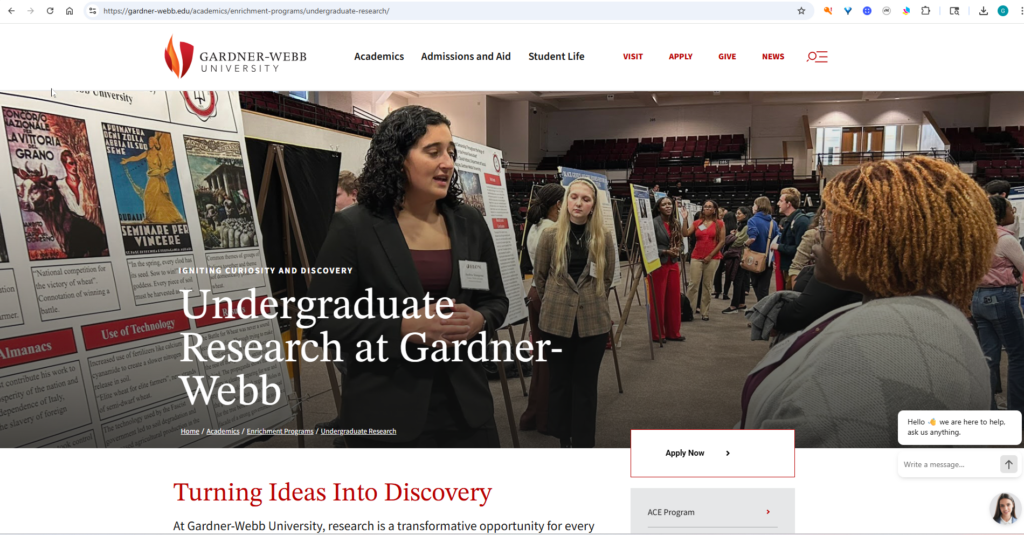
If you are a student reading this and wondering where to begin, Gardner-Webb’s Undergraduate Research program is a great place to start. Whether it is a summer fellowship, a course-embedded project, or presenting at the Life of the Scholar (LOTS) Conference, the goal is simple. Take an idea and turn it into something real. With faculty mentorship and opportunities to share your work beyond campus, research becomes less about writing papers and more about asking better questions and discovering what you are capable of. You can learn more here: https://gardner-webb.edu/academics/enrichment-programs/undergraduate-research/
A Line Worth Holding Onto
Near the end of the episode, Dr. Amato offered a line that captures the spirit of the conversation: “Allow yourself to be captured by curiosity. Embrace it.”
It connects naturally to the idea she shared in her earlier appearance on the podcast, drawing from Aristotle, that wisdom begins in wonder.
Taken together, those ideas offer a clear message. Curiosity is not something to set aside or treat as a distraction. It is often the starting point for the most meaningful work students will do. When they follow it, even when the path is unclear, they tend to find growth, direction, and confidence along the way.
What This Really Shows
It would be easy to frame this episode as a story about success. A strong student, a research project, a leadership role, an internship. All of that is true, but it is not the most important part.
What matters is the pattern underneath it. A student who kept asking questions. A willingness to try things before feeling fully ready. The presence of mentors who encouraged that process. And a series of small decisions that built into something much larger.
For students, the takeaway is straightforward. You are likely capable of more than you think, but you have to be willing to test that.
For faculty and staff, the reminder is just as important. The conversations, the encouragement, and the quiet moments of support often have a longer reach than we realize.
Because in many cases, that is where it starts.