
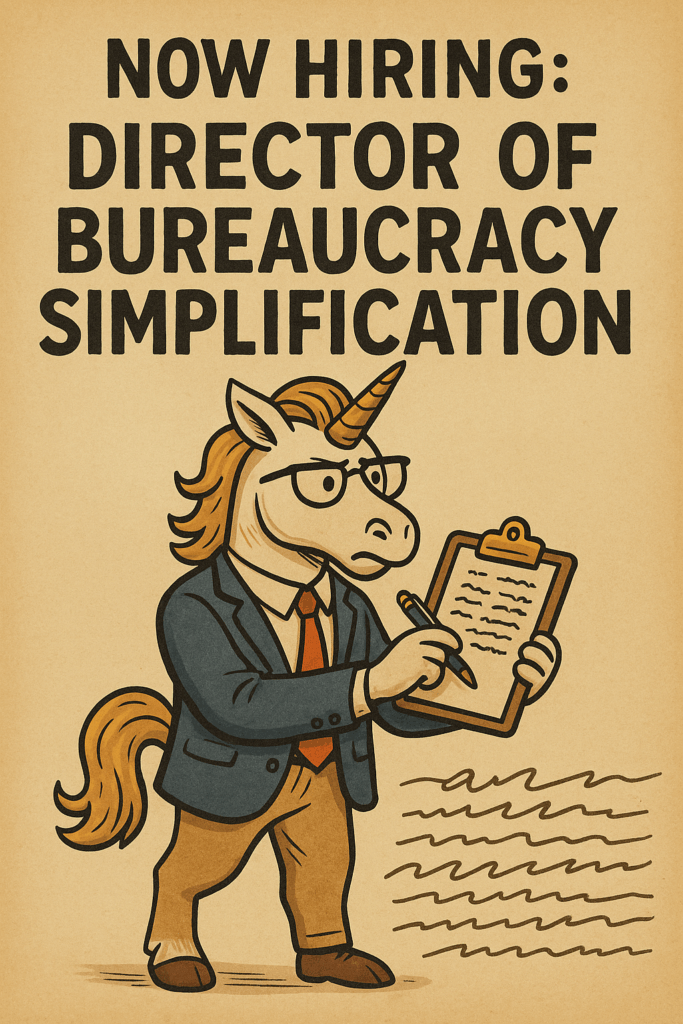
The Campus Hero Who Can Spot a Ridiculous Practice From 50 Yards Away
Every college has them, the baffling rules, the extra steps, the hoops you jump through that make no sense to anyone but the person who wrote them. Some have been around for decades. Others are brand new, created to solve problems that don’t exist, solutions in search of a problem, designed to address a “crisis” that only exists on paper, or in someone’s imagination. The results are the same: more obstacles and higher costs for students, challenges in making to graduation, and wasted time for faculty and staff.
In Bankrupt U, Bill Quain and Joe Corabi describe the problem with unusual bluntness: colleges are businesses, and “paying students are the lifeblood” that keeps them running (Quain & Corabi, 2024, p. 9). Students become “ATMs,” alumni become “slot machines,” and the system keeps turning because no one is paid to stop the nonsense. That’s why every institution needs a Director of Bureaucracy Simplification, or, more directly, a Director of B.S. This role would lead the Student Needs and Fairness Unit (S.N.A.F.U.), track down any Policy, Operating practice, Or Procedure that wastes time or hurts students (P.O.O.P.), and flush it….. I mean remove it.
The Director of B.S. would not answer to the same people who created or protect these bad ideas. They would report to an independent oversight committee made up of alumni, students, external higher ed professionals, and members of the Board. For administrative needs, they would have a dual reporting line to the president’s office. But their accountability is to the committee, giving them the independence to speak truth to power, and the authority to make change.
And for the record, this is not the education-world equivalent of “D.O.G.E.” , random, chaotic, and fueled by meme energy. The concept is delivered with humor, but the work itself would be serious, practical, and collaborative (even if some folks would rather not collaborate).
Why This Role is Needed (and Why It Should Have Existed Years Ago)
I have spent nearly 20 years in higher education, and I’ve lost count of the number of policies, operating practices, or procedures that do more harm than good that I’ve encountered. I’ve seen course requirements that ignore equivalent transfer credit because it comes from the “wrong” department. I’ve seen procedures requiring students to get a half-dozen signatures, in person, from throughout campus, just to take a leave of absence or even withdrawal from the university. I’ve seen adult transfers forced to take extra general education classes just to satisfy a “branded” requirement, even when their prior coursework clearly meets the learning outcomes.
None of these rules are harmless. They put up barrier after barrier, making it that much easier to stop out. They cost students money they don’t have. They delay graduation and drive attrition. They waste advisor time untangling degree audits and increase the likelihood of frustrating advising errors. They burn faculty energy on workarounds instead of teaching. And, as Quain and Corabi point out, these inefficiencies are not accidents, they’re baked into a system that treats students as revenue streams, not as people working toward a life goal (2024, pp. 9–12).
The Director of B.S. is not a vice president or cabinet role. That level of appointment would tie it too closely to the political and budgetary priorities of senior leadership. It would make it difficult to enact change within units. Nor should it be a faculty-led position. Faculty do important work, but they are sometimes part of the problem, in fact, almost all of the truly baffling curriculum hurdles and non-sensical requirements originate there. In the way curriculum is designed and programs are structured, personal or departmental interests can outweigh what is best for students or the institution. I know this is not a popular opinion. As a former faculty member and administrator who still embraces my faculty identity, this is not me throwing darts, it’s me looking in the mirror as well. Yes, I know administrators create a high volume and distinct form of P.O.O.P.
Many faculty have never worked in what we often call the “real world.” At times, curriculum and programs are developed in a vacuum. I include myself in this group. I went straight from my own education into a faculty role. While I’ve done some consulting work in my field/discipline, I’ve learned the value of seeking input from people working directly in the field to ensure programs are relevant, modern, and future-ready. This is why adjunct faculty are often so important (and why they deserve better pay and fewer barriers than they currently face, though that’s an article for another time).
One of the biggest advantages of the proposed structure for the Director of B.S. is its ability to cut through the unfortunate side of shared governance. At its best, shared governance ensures faculty, staff, and administration work together to make decisions that balance mission, quality, and resources. In reality, and at times at its worst, it becomes a defensive shield for the status quo, where even modest changes are met with reflexive opposition (and staff and students are not really at the table anyway). As Brian Rosenberg observes in Whatever It Is, I’m Against It, higher education has a deep cultural resistance to change, a tendency to oppose anything that disrupts established routines. The Director of B.S., operating under independent oversight from alumni, students, external higher education professionals, and members of the Board of Trustees, with administrative support from the president’s office, could sidestep that reflex and focus squarely on solutions that improve student outcomes and institutional effectiveness.
Fixing these problems from within the existing administrative or faculty hierarchy doesn’t work. Too many decisions are filtered through the same layers that created the problem, with every department protecting its own turf. The Director of B.S., operating under independent oversight, could address these issues without political interference, ensuring that the student experience and the institution’s long-term health come before outdated traditions, self-interests, or manufactured crises.
What’s Clogging the System
Some barriers to student and employee success are written in official policy. Others aren’t written anywhere; they’ve just been passed along in training or kept alive by the “this is how we’ve always done it” mindset. Regardless, they slow things down, create frustration, and keep the institution focused on process over purpose.
The work of this role would cut across every division on campus, from Academic Affairs to Student Life to Enrollment and beyond. It’s policy detox, myth busting, barrier removal, and red tape triage. It’s also impact forecasting, asking not only “What’s broken?” but “What happens to students, staff, and faculty if we do (or don’t) fix it?” The Director of B.S. wouldn’t be limited to any one office or department. Their scope would cover curriculum and degree requirements, administrative inefficiencies, unnecessary academic, residential, and even internal athletic hoops or steps, student support barriers, housing contradictions, and more. That includes outdated rules, practices that have outlived their purpose, and “solutions” to problems that never really existed.
System Navigation Barriers
Some rules and practices make it harder for students to get the help they need or simply move forward in their academic journey. These barriers often appear in advising, registration, and course access, and they can derail momentum for no good reason.
- Advising Gaps and Overload: High student-to-advisor ratios are only part of the problem. At many institutions, advising is undervalued, undertrained, and inconsistently executed. When faculty have advising responsibilities, some excel —investing time, care, and expertise into guiding students — while others approach it with indifference, minimal preparation, or no real focus. Perhaps still using degree plans from years ago that don’t reflect 3 levels of change to the program. Students quickly figure out who the “good” advisors are and start seeking them out, which shifts the workload from reasonable to overwhelming for the best advisors. The irony is that those who do it well get little credit toward tenure or promotion, while those who do it poorly are often rewarded for their mediocrity. It’s the academic version of a family chore dodge; do a terrible job folding the laundry, and watch the task get reassigned to a sibling. The result is burnout for strong advisors and inadequate support for the students who can’t get to them. Worse yet, it increases the chance of advising errors that result in fear and panic in their senior year cause they are missing a class that they could have easily taken in year 2 or 3 if advised properly. The number of overrides or administrative substitutions I’ve approved to avoid adding a semester to take a single class is astounding.
- Pointless Enrollment Restrictions: Some institutions still operate under the belief that if residential students can take online courses, they’ll hole up in their dorm rooms and never leave. This mythical “hermit student” fear drives restrictions requiring students to get special permission for online versions of required courses (or not allow them at all). There’s also a lingering assumption, perhaps valid in the early days of online education, that typical 18-year-olds simply can’t handle the responsibility of an online class. In reality, especially after the COVID era, most students are far more adept with online learning than we give them credit for. Yes, some (many) need guidance in managing time and navigating the learning process in digital platforms where some classes have less structure, but the blanket restriction ignores a decade of progress in both technology and student readiness (not to mention hurting the adult students –– seriously, adopt the “modern learner” paradigm already). I’m sorry, if an instructor is still coasting in their online class by overly relying on voice-over presentations and discussion forums they don’t engage in, they really shouldn’t criticize students’ ability to learn in online modalities.
- Rigid and Cascading Prerequisite Chains: Unnecessarily strict prerequisite requirements can create a scheduling nightmare for students and staff alike. Miss or drop one class, even for a legitimate reason like illness, workload balance, or a personal emergency, and the fallout can stall progress for an entire year. One missed course can delay the next course in the sequence, which delays the one after that, creating a domino effect that can push graduation back by semesters. This rigidity often has little to do with true mastery of material and more to do with historical sequencing that no one has revisited in years or is willing to do the hard work of modernizing the program. Yes, there are some situations where you need to understand or even master some material/skills before tackling the next topic. But so many programs could have few, if any, prerequisites, giving the most flexibility to students andthe ability to navigate their education and life at the same time. Crazy thoughts, I know!
- Overcomplicated Processes: Multi-step forms, duplicate approvals, or outdated manual systems can turn simple tasks into multi-week ordeals. Students may have to submit the same information to different offices, wait for unnecessary signatures, , navigate confusing chains of approval, or get 10,000 steps going to half a dozen offices to collect signatures, all for actions that could be completed in minutes with modern tools (e.g. Docusign). The inefficiency frustrates students, staff and faculty alike, wastes institutional resources, and adds friction at every step of the student experience.
- Hidden Rules: Not every barrier is written down. Many are embedded in the institutional culture, practices passed down through training or habit, with no documented rationale. The hidden curriculum’s hidden curriculum. Students and even staff often discover these “rules” only when they unknowingly break them, adding unnecessary stress and creating the perception that the institution is opaque and unhelpful.
Student Life and Housing Challenges and Contradictions
Housing policies can be a significant source of unnecessary stress, especially when the rules don’t align with reality. I’m sure there are more examples (and I’d welcome input from my colleagues in residence life and student engagement), but even from my vantage point, a few problems I’ve observed stand out:
- Bed-Defying Residency Rules: Research shows that students who live on campus for their first two years are more likely to be retained, persist to graduation, and feel more connected than those who commute from the start. That’s understandable, and encouraging juniors and seniors to stay can also have benefits. But I’ve seen institutions push this idea to the extreme, creating a four-year on-campus residency requirement, even when they don’t have enough beds to house everyone. The result? A housing lottery where students essentially compete for the right not to follow the policy, which undermines its credibility. I understand that room-and-board revenue is important (COVID made that painfully clear), but forcing students to stay without addressing the underlying reasons they seek exemptions is not the answer.
- Inflexible Waiver Policies: Students with legitimate personal, medical, or financial reasons to live off campus often face drawn-out, inconsistent, overly strict or sometimes arbitrary approval processes. This rigidity pushes students and parents to find workarounds, exploit loopholes, or push boundaries to achieve the outcome they need. In practice, I’ve seen more than half of a single athletic team secure medical waivers simply because campus dining hours or menu options don’t fit their training schedules or dietary needs, an entirely avoidable situation if policies and services were more adaptable. I’ve also seen the strain this puts on Student Accessibility/Disability Offices and staff, who end up spending far too much time on these waiver cases instead of focusing on learning accommodations and other critical student needs.
Administrative Inefficiencies and Bloat
Some institutions operate with administrator-to-student ratios that make no sense (administrative bloat), while others stretch single staff members across two, three, or even four jobs (that may or may not be related). Both extremes hurt efficiency and service quality. Too much administrative layering creates unnecessary approval steps, slows decision-making, and can foster a culture of protecting turf over solving problems. On the other hand, chronically overloaded positions lead to burnout, high turnover, and gaps in service.
Poor leadership makes all of this worse. When managers micromanage, fail to give employees autonomy, or refuse to empower them to do their work, it creates barriers that no one but that supervisor can remove. And in many cases, those leaders lack the self-awareness, or willingness, to even acknowledge the problem. The result is a bottleneck where progress depends entirely on the person most committed to maintaining control.
The Director of B.S. could pinpoint where roles overlap unnecessarily, where workloads have become unsustainable, and where responsibilities have drifted over time without formal review, addressing bloat and burnout in equal measure. They could also call out the narcissistic and controlling behavior of some in aways direct reports never can. That includes confronting the quiet costs of “that’s just how we’ve always done it” in administrative operations.
- Duplicate or Obsolete Policy Versions: When outdated policies remain online alongside updated ones, it creates confusion for students, faculty, and staff. Worse, it opens the door to compliance errors because people can’t tell which version to follow.
- The Syllabus Shuffle: Faculty are still required to email, or worse to print and physically deliver, copies of syllabi to a dean’s office, even though every syllabus already exists in the LMS and can be accessed instantly. This wastes faculty time, paper, and administrative effort, with no measurable benefit. Still, the syllabi aren’t easily accessible. Students looking to transfer need it. Faculty looking to make revisions to their programs and may want to include a course from outside their department as an elective or requirement could see exactly what is covered. Administrators working to evaluate and manage the institution portfolio of programs would benefit from easy access as well. Finally perspective students and parents can easily get a sense of what a program would offer them.
- Policy Silos and Broken Continuity: In many roles, there’s no structured onboarding for the policies specific to that job. New employees often learn the rules only after they’ve broken one. This problem deepens when there’s no overlap between an outgoing staff member and their replacement (which is 98% of the time). Every week without a proper handoff forces the new hire , or an interim, to piece together processes without a full understanding of how their decisions ripple across the larger system. For every week that goes by before a new hire starts, the time it takes for them to get up to speed and be productive and effective in their role increases exponentially. For example, I’ve seen that when there has been a 6-month gap, it takes the individual a year plus to acclimate and get “up to speed”. Worst-case scenario – they may leave within 1-2 years due to frustration, poor performance as a result of “failure to launch” or other issue. That “guesswork” can inadvertently create new barriers and inefficiencies that take months or years to undo.
- Skewed Staffing Models: Administrative structures with overlapping duties, unclear lines of authority, or misaligned reporting relationships drain resources and slow institutional progress. These inefficiencies can also mask areas where key functions are under-resourced, allowing both overstaffing and understaffing to exist at the same time
Curriculum and Degree Requirements
While curriculum is central to a university’s mission, it’s also one of the most common places for outdated or self-serving decisions to take root. Too often, programs and courses are designed around the needs, schedules, and assumptions of the “traditional” student, not the traditional student of today, but the one who existed decades ago. Today’s modern learner, whether 18 or 48, often behaves more like an adult learner in terms of expectations, responsibilities, and learning preferences. Yet many institutions still rely on pedagogy designed for a bygone era rather than incorporating andragogical principles that better serve this new reality. This mismatch leads to rigid course structures, irrelevant requirements, and missed opportunities to connect learning directly to students’ current and future goals. The Director of B.S. could help ensure curricular requirements serve students first, not the preservation of departmental or program fiefdoms or the defense of tradition for its own sake.
- The Branded Degree Hoops: Adult transfer students often arrive with extensive prior coursework that clearly meets the spirit and letter of general education outcomes. Yet they’re forced to take extra classes simply to satisfy a “branded” institutional requirement. For example, a course in ethics or leadership from an accredited university may check every box for critical thinking or communication, but because it doesn’t carry the home institution’s prefix, it’s dismissed. This wastes student time, increases debt, delays graduation, and sends a message that institutional branding matters more than student progress. Credit for prior learning is a non-starter at many institutions. Whether it is the stigma from the (rightfully) horrible “credit for life experience” policies of for-profits and degree mills or simple lack of understanding how credit for prior learning could be structured to actually work.
- Department-Guarded Requirements: General education categories like foreign language, math, or writing sometimes “count” only if taken in specific departments. A perfectly valid business math course may be excluded from fulfilling a quantitative reasoning requirement because it wasn’t taught in the math department. Similarly, a communications course focused on writing might not count toward a writing-intensive requirement unless taught by English faculty. Foreign language requirements that selectively exclude certain languages to avoid students from not taking their courses. These turf-protection moves have little to do with learning outcomes and everything to do with departmental control.
- Major Protectionism: Some majors keep certain courses on the “required” list not because the content is essential or develops critical skills, but because removing it might weaken the case for the program’s, or an individual instructor’s, survival. This practice keeps enrollment numbers artificially propped up (if at all) for those classes but forces students to spend time and money on courses with little direct connection to their career or academic goals. In some cases, the course could have direct relevance, even for students outside the major, if it were updated and redesigned with meaningful input from professionals in the field or those in other disciplines. But the unwillingness to make significant changes, and the resistance to incorporating outside perspectives from those working in the “real world” turns that potential into a missed opportunity. It’s a clear example of institutional self-preservation at the expense of student-centered design.
- Faculty Territorialism: Degree plans sometimes still include courses that haven’t been meaningfully updated in years, if not decades. These may exist because no one wants to relinquish a course they’ve long taught or tell a senior faculty member their course needs a serious review/revision. Even when the content no longer reflects current industry practices or societal needs. The result is students graduating with outdated skills or knowledge, a problem that could be avoided by regularly auditing courses for relevance and value.
- Scheduling and Room Utilization Gridlock
Few things drain time and patience faster than the game of academic Tetris known as course scheduling. Instead of aligning offerings around student needs and graduation pathways, schedules are often shaped by faculty preferences that have little to do with real-life constraints (“I just don’t like teaching before 10 a.m.”) rather than genuine obligations like childcare or medical needs. Layer in poor room utilization, with prime spaces “owned” by certain departments, held hostage for events, or blocked for outside rentals, and you have a recipe for frustration.
The result? The person responsible for scheduling spends countless hours playing referee between departments, event services, and faculty, only to end up with bottlenecks that prevent students from getting the courses they need when they need them. This isn’t just an operational headache — it directly impacts students’ ability to graduate on time. My colleague, Chris Morett (host of EdUp: Campus Planning), who advises and consults on scheduling optimization and space usage, can attest: when schedules and rooms aren’t managed strategically, inefficiency spreads like a campus rumor, wasting money, delaying degrees, and tanking student satisfaction.
All these examples are just the tip of the academic iceberg. There are likely hundreds and hundreds more examples across different institutions.
Why This Role Pays for Itself
The Director of B.S. is not a “nice to have”, it’s a position with a direct return on investment in time saved, resources conserved, and students retained. The numbers speak for themselves:
- Reduced Staff and Faculty Time Wasted on P.O.O.P.
If 200 staff members each spend just one hour per week navigating unnecessary requirements, outdated processes, or redundant paperwork, that’s 10,000 hours annually. At a conservative $25/hour, that equals $250,000 in lost productivity — the equivalent of more than five full-time positions consumed entirely by inefficiency.
And that’s just looking at staff. If we include faculty, even conservatively estimating 400 total staff and faculty combined, that figure doubles to $500,000 per year. In reality, it’s likely much higher, especially given the significantly higher value of faculty time. Push the estimate to four hours per week (which is not uncommon when you account for duplicated reporting, redundant approvals, and workarounds for outdated systems), and the total soars to $2,000,000 annually. With even modest refinements to this calculation, you could make a strong case for saving or preventing costs in excess of $3–$5 million per year. - Improved Faculty Efficiency and Student Satisfaction
Removing administrative hoops frees faculty to focus on high-impact activities, teaching, advising, mentoring, and research, all proven drivers of student engagement, retention, and persistence. Even a modest 5% improvement in instructional and advising efficiency can pay dividends in learning outcomes and program quality.
The ripple effects extend to student satisfaction: more timely feedback, stronger faculty-student relationships, and better access to guidance outside of class. Research consistently shows that students who feel connected to their instructors are more likely to stay enrolled, progress on time, and graduate.
From a revenue perspective, the math is compelling. At a university with 5,000 students, a 2% increase in retention equates to roughly 100 additional students staying enrolled. If each student generates $15,000 in annual tuition and fees, that’s an additional $1.5 million in revenue for the institution, per year. Combine that with gains from increased persistence and reduced time-to-degree, and the annual financial benefit could easily climb toward $2 million or more. - Better Graduation Rates and Long-Term Alumni Value
Improving graduation rates delivers benefits far beyond the institution’s reputation. As Gary Stocker of College Viability and the College Financial Health show with Matt Hendricks notes, schools with 4-year graduation rates that don’t meet the 40% bar are simply in the business of tuition collection and little else. Students who complete their degrees on time, and do so truly workforce-ready, are better positioned for strong starting salaries, career advancement, and long-term success. That success translates into more satisfied alumni who are not only more likely to recommend the institution but also more inclined to give back, both financially and through networking and mentoring.
The financial impact is significant. At a 5,000-student institution with average annual tuition of $15,000, a 2% increase in the four- or six-year graduation rate could equate to roughly $1.5 million in additional tuition revenue over the period those students remain enrolled — before factoring in savings from reduced recruitment costs. Over the long term, graduates who are more satisfied and better connected to the university’s mission are more likely to donate, hire fellow alumni, and create opportunities for current students, adding indirect but substantial value.
The impact doesn’t stop at first jobs. By maintaining strong relationships with graduates and offering opportunities for them to retool, pivot careers, or upskill through continuing education, the institution can turn alumni into repeat learners. This creates ongoing tuition revenue and strengthens the alumni network, which in turn benefits current students through internships, job placements, and professional mentorship.
Even a modest increase in the percentage of students graduating within the expected timeframe can set off a compounding effect — higher alumni earnings, stronger giving, and a richer student-alumni ecosystem that becomes a selling point for future enrollment. - Lower Compliance and Error Costs
When policies are outdated, contradictory, or poorly communicated, they create a minefield for compliance — not because employees are careless, but because the rules themselves set them up to fail. Every unclear procedure or overlapping policy increases the likelihood of missteps that can lead to formal grievances, student or employee complaints, regulatory citations, or even legal action. These issues don’t just drain time and morale; they carry a direct financial cost.
A single protracted HR grievance can easily cost $10,000–$20,000 in investigative time, legal review, and administrative processing, even before considering settlement costs. For institutions navigating federal regulations like Title IX, ADA, or financial aid compliance, one significant violation can climb into the six- or even seven-figure range when you include fines, legal fees, and mandated corrective actions. And those numbers don’t reflect the reputational damage or the opportunity cost of pulling staff away from their primary responsibilities to manage a preventable mess.
Proactive policy review, consolidation, and simplification can dramatically reduce these risks. If the Director of B.S. role prevented even one major compliance incident per year, the avoided costs could cover a substantial portion — if not all — of the position’s salary. Add to that the dozens of smaller issues that never escalate because policies are clear, consistent, and user-friendly, and the annual savings can easily exceed $250,000–$500,000 at a mid-sized university.
The payoff is more than financial. By reducing compliance errors and grievances, the institution builds trust among students, faculty, and staff, replacing a culture of fear and confusion with one of clarity, fairness, and confidence in the system. - Reputation and Recruitment Value
An institution known for cutting needless bureaucracy sends a clear signal to students, parents, alumni, community leaders, and prospective employees: this is a place that values efficiency, fairness, and action over empty process. That reputation doesn’t just help with student recruitment, it becomes an institutional brand asset.
When prospective students and families hear consistent stories about how the university removes barriers and solves problems quickly, yield rates improve. Even a 1% increase in yield for a school enrolling 1,000 new students at $15,000/year in tuition represents an additional $150,000 annually, without adding any marketing spend. That same clarity and responsiveness also attract top faculty and staff who want to work in an environment where they are empowered rather than micromanaged.
Externally, a reputation for nimble, solution-oriented operations makes the institution more appealing to corporate partners, city and state agencies, and community organizations that value efficiency and reliability in a partner. Those partnerships often translate into sponsored programs, workforce pipelines, research collaborations, and philanthropic support, all of which have direct financial value. Even a modest partnership generating $50,000–$100,000 annually in grants, training contracts, or in-kind support can compound over time, especially when multiplied across multiple sectors.
The Director of B.S. role amplifies this effect by removing the internal friction that too often derails external collaborations before they start. A smoother internal system makes it easier to say “yes” to opportunities and to deliver on commitments in a way that strengthens trust, brand reputation, and long-term institutional viability.
What Happens When You Flush the P.O.O.P.: Estimated Annual Savings and Potential Revenue Gains.
Category | Estimated Annual Impact | Notes |
Reduced Staff & Faculty Time Wasted | $250K–$2M+ | Increased efficiency by eliminating low-value tasks |
Faculty Efficiency & Student Satisfaction | $375K–$750K | Retention bump from better teaching/advising |
Improved Graduation Rates & Alumni Value | $1.25M+ | Faster completion + alumni returning for more programs, retooling, upskilling |
Lower Compliance & Legal Costs | $100K–$250K | Fewer disputes, grievances, and audit issues |
Reputation & Partnership Value | $250K+ | Attracts high-value corporate, government, and donor partnerships |
Estimated Total: $2.2M – $4.5M annually.
Truly, these estimates are conservative and have been put together little minimal data collection. Thus, the total value could be significantly higher.
Final Thoughts
After years of watching higher education trip over its own shoelaces, it’s clear that our problem isn’t a lack of talent, effort, or good intentions, it’s the sheer volume of P.O.O.P. clogging the system. Policies that no one remembers writing. Traditions that no one dares question. Processes that take longer to complete than the actual work they’re supposed to support. We’ve got the academic equivalent of a hoarder’s basement: a maze of outdated junk, valuable ideas buried under debris, and a lingering hope that “maybe we’ll need this someday.” Spoiler: we won’t.
The cost isn’t just in wasted hours or lost patience, it’s in student trust, faculty morale, and institutional credibility. Every time we make someone navigate three forms, two signatures, and a trip across campus to accomplish something that should take five minutes, we send the message that bureaucracy matters more than people. And the longer we accept that message, the deeper it gets baked into the culture.
That’s why the Director of B.S. isn’t a punchline, it’s a survival strategy. Someone with the authority, independence, and frankly, the stamina to call out the absurd, cut through the nonsense, and make room for policies and practices that actually serve students and the people who work with them. No more hiding behind “that’s how we’ve always done it.” No more sacred cows grazing on the productivity of everyone else. No more processes that exist only to feed themselves.
Check out the position description for the "Director of Bureaucracy Simplification"
References
Rosenberg, B. (2023). “Whatever it is, I’m against it”: Resistance to change in higher education. Harvard Education Press.
Quain, B., & Corabi, J. (2024). Bankrupt U: Students, parents and alumni are going broke, & colleges don’t give a C.R.A.P. Wales Publishing Company.
Image attribution:
OpenAI. (2025). Now hiring: Director of Bureaucracy Simplification [Digital illustration]. Generated with DALL·E. Retrieved from https://openai.com/dall-e