
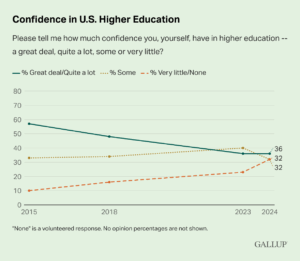
In recent years, American higher education has been facing a significant decline in public trust and confidence. According to a recent Gallup survey, U.S. adults are almost evenly split in their confidence levels, with 36% expressing high confidence and 32% expressing little or no confidence in higher education (Gallup.com). This marks a sharp decline from 2015, when 57% had a great deal of confidence in colleges and universities (Gallup.com). The factors driving this decline are multifaceted, but three key reasons stand out: perceived political agendas, a mismatch between education and market needs, and the ever-increasing cost of education.
Interestingly, while four-year institutions are grappling with these issues, a separate Gallup poll reveals an increase in public confidence in two-year schools. The poll indicates that 41% of Americans now express high confidence in community colleges, up from 37% in 2020 (Gallup.com). This divergence suggests that two-year schools are perceived as more adaptable and aligned with workforce needs, offering insights into how four-year institutions might regain public trust.

The perception of political agendas within higher education institutions has become a major contributor to the declining trust in American colleges and universities. The Gallup survey reveals that a significant portion of the population believes that universities lean too heavily towards liberal ideologies, with 41% of those expressing low confidence citing this as a primary concern. This sentiment is particularly pronounced among Republicans, where confidence in higher education has drastically fallen to just 20% (Forbes).
Recent protests on college campuses, particularly those related to the Israel-Palestine conflict, have further fueled perceptions of political bias. NPR reported on widespread protests across campuses in response to the ongoing Israel-Gaza conflict, highlighting how students and faculty have engaged in heated debates over institutional positions and perceived biases (NPR). Similarly, the BBC covered how tensions have escalated, with some universities facing criticism for either supporting or condemning certain political viewpoints (BBC). This polarization reflects a larger societal divide and exacerbates the challenge for educational institutions to maintain an environment of balanced discourse.
This issue of political bias is echoed in a report by Best Colleges, which notes that 60% of Americans believe that higher education institutions have a political agenda, potentially alienating students who feel their perspectives are not represented (Best Colleges). The challenge lies in striking a balance between academic freedom and political neutrality, a delicate act that many institutions are still struggling to master. In doing so, schools must continue to teach students civic discourse and how to navigate difficult conversations. These skills are essential not only for the workplace but also for fostering a healthy, democratic society where diverse perspectives can be heard and respected.

There is work to be done to shift the perceptions that higher education is moving in the wrong direction.
To rebuild trust and confidence, higher education institutions must leverage their strengths while embracing modernization and entrepreneurship. Addressing the three critical areas of concern—political agendas, educational relevance, and cost—will be essential in regaining public confidence and providing real value to students.
1. Addressing Political Agendas
Promote Balanced Discourse:
Institutions must create an environment that fosters open dialogue and respects diverse viewpoints. By promoting civic discourse and teaching students how to navigate difficult conversations, universities can prepare students for a democratic society and workplace where varied perspectives are valued. Schools should offer forums, debates, and courses that encourage students to engage with different ideologies and develop critical thinking skills, ensuring that education remains a space for learning rather than indoctrination.
Transparency and Inclusivity:
Higher education institutions should strive for transparency in their policies and practices, demonstrating a commitment to inclusivity and fairness. This includes clear communication about the university’s values, encouraging feedback from the campus community, and actively addressing any perceived biases. By involving students, faculty, and staff in policy development, schools can build trust and demonstrate their dedication to a balanced educational environment.
Accountability:
There is a growing demand for transparency and accountability from educational institutions. More than 90% of Americans believe that colleges should provide publicly available data on graduation rates, employment outcomes, and other key performance indicators. While some of these metrics are accessible through platforms like IPEDS and university websites, there is room for improvement. The upcoming Financial Value Transparency (FVT) requirements and updates by accrediting bodies will enhance accountability, providing clearer insights into institutional performance. However, meeting these demands will require significant effort from university Institutional Research (IR) offices to collect, analyze, and present this data effectively.
2. Aligning Education with Market Needs
To address the disconnect between educational offerings and market demands, universities need to focus on aligning their curricula with the skills and competencies required by employers. Institutions can benefit from collaborations with industry leaders and alumni to ensure that graduates are equipped with both technical and soft skills. Additionally, incorporating experiential learning opportunities, internships, and co-op programs can provide students with the practical experience needed to succeed in the workforce.
Accessibility:
Despite the perceived value of degrees, many Americans still face barriers to accessing higher education. Improving accessibility by offering flexible learning options, financial aid, and support services can help expand the pool of students reached and enrolled. By breaking down these barriers, institutions can attract a more diverse student body and fulfill their mission of providing education to all who seek it.
3. Tackling the Cost of Education
Financial Aid and Scholarships (but also reducing costs and increasing revenue):
Increasing financial aid options and scholarships can help alleviate the financial burden on students and make higher education more accessible. Schools should work to provide transparent information about financial aid opportunities and actively seek partnerships with businesses and alumni to fund scholarships. However, simply increasing financial aid and scholarships will only go so far. Institutions must also do the difficult work of reducing costs and increasing revenues to ensure long-term sustainability. This is where an entrepreneur mindset and bold decisions could be critical for some schools. This doesn’t come without risk, but with calculated risk you’ll see some schools leap ahead of the competition. The biggest challenge will be the “status quo” and that isn’t the “name the school” way mentality found throughout high ed (Check out Brian Rosenberg’s, “Whatever It Is, I’m Against It”: Resistance to Change in Higher Education.)
Efficiency and Affordability:
Universities can explore cost-saving measures that do not compromise educational quality, such as streamlining administrative processes and optimizing resource allocation. Investing in technology to improve efficiency can also reduce operational costs, allowing savings to be passed on to students.
Highlighting ROI:
With new regulations on gainful employment and financial value transparency reporting, institutions have an opportunity to showcase their return on investment (ROI). By providing clear data on graduates’ career outcomes and financial value, universities can address concerns about cost and highlight the tangible benefits of their programs. This transparency will not only meet regulatory requirements but also attract prospective students who are increasingly concerned about the value of their education.
Leveraging Existing Strengths
Institutions should prioritize what students want and need without abandoning their commitment to liberal arts education. By aligning their offerings with market demands, colleges can ensure that students receive a well-rounded education that prepares them for success in their careers and personal development. Schools need to shift their focus to areas they already excel in, such as career development, student support services, and other co-curricular and curricular opportunities that significantly impact their initial and long-term ROI.
This doesn’t mean schools have to abandon their focus on the liberal arts; rather, they need to shift priorities to align more closely with student needs and market demands. By doing so, colleges can continue to provide a well-rounded education that fosters personal and professional growth, reinforcing the enduring value of a college degree.